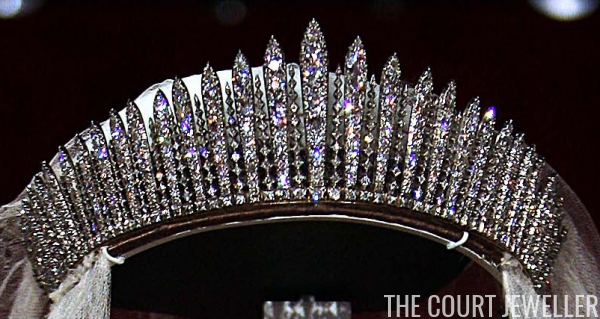
Often confused with the many other fringe tiaras and necklaces in the royal collection, Queen Mary’s Fringe Tiara is a piece that was commissioned by Queen Mary and then immortalized as Queen Elizabeth II’s wedding tiara.
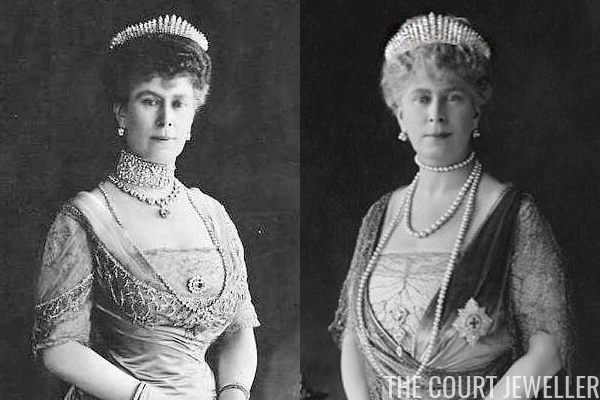
This tiara is often misidentified as the “George III Fringe Tiara” or the “Hanoverian Fringe Tiara.” But don’t let the internet (and even some books) fool you—it’s not the same tiara! The so-called George III or Hanoverian Fringe was a fringe necklace that belonged to Queen Adelaide, the wife of William IV. It was worn in various ways (including as a tiara) by Queen Victoria, Queen Alexandra, Queen Mary, and Queen Elizabeth, and it is now the property of the current queen. But it’s a totally different piece.
Hugh Roberts called Queen Adelaide’s fringe a tiara of “less finely graduated form,” noting that it is “now set as a necklace” (and presumably cannot be easily converted to be worn as a tiara). Queen Mary’s fringe, on the other hand, he describes as a “new, smaller, neater and more modern-looking tiara.” You can see a comparison of the two in the photo montage above; Queen Adelaide’s fringe is on the left, and Queen Mary’s is on the right.
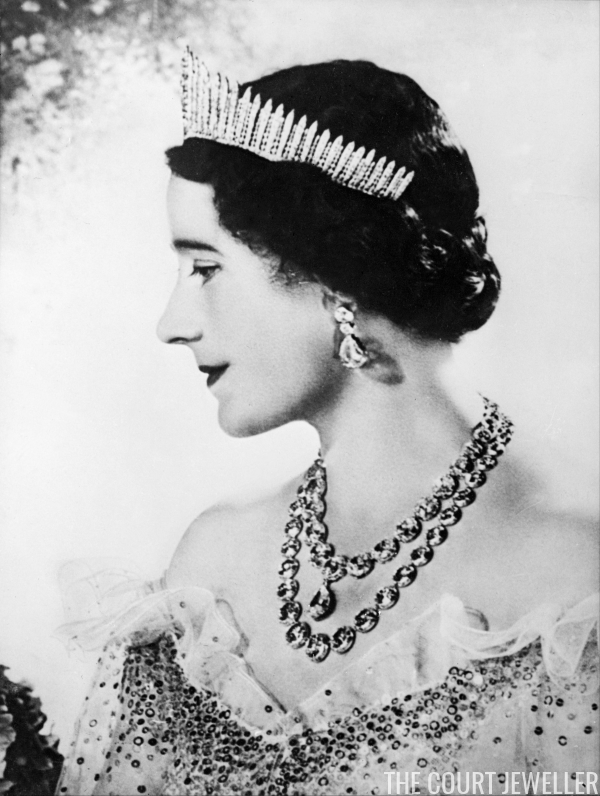
Queen Mary’s fringe tiara is much newer than Queen Adelaide’s necklace. It was made of diamonds set in gold and silver by E. Wolff and Co. for Garrard in 1919. The diamonds are a bit older than that, though; they were a part of a necklace made by Collingwood that Queen Victoria gave to Mary as a wedding gift in 1893. But Queen Mary the jewelry innovator struck again, dismantling that gift and re-using the diamonds to make this fringe.
We’ve talked in the past about how incredibly popular these diamond fringe tiaras were after they became fashionable at the imperial court of the Romanovs, and the current Windsor collections reflect that popularity. Along with this fringe tiara and Queen Adelaide’s fringe necklace/tiara, the present Queen also has Queen Alexandra’s fringe kokoshnik tiara, plus a diamond fringe necklace that once belonged to Princess Victoria (sister of George V) and the diamond fringe necklace (the “City of London” fringe) that she received as a wedding present in 1947.
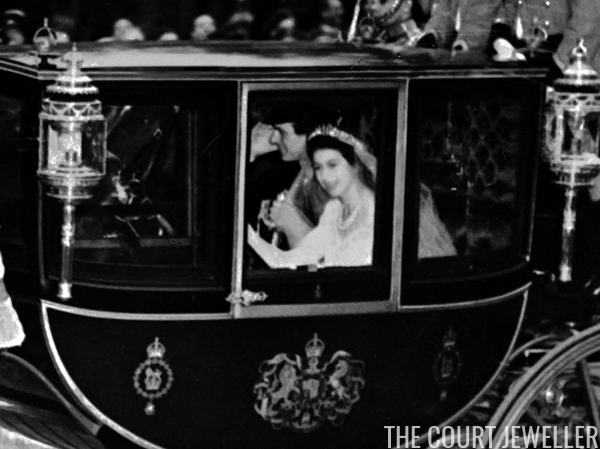
Queen Mary gave the tiara to her daughter-in-law, Queen Elizabeth, in 1936. It was actually Elizabeth who loaned the tiara to her daughter, the future Elizabeth II, to wear at her wedding in 1947. By now many of you have probably heard the famous (and true) story about the tiara mishap at that wedding: when the tiara was placed on the bride’s head, it snapped and had to be quickly mended by a jeweler from Garrard before she could leave for Westminster Abbey. In the close-up photos of the bride, you can see a small space between the center fringe and the larger spike immediately to its right; that space is a result of the hasty repair of the frame.
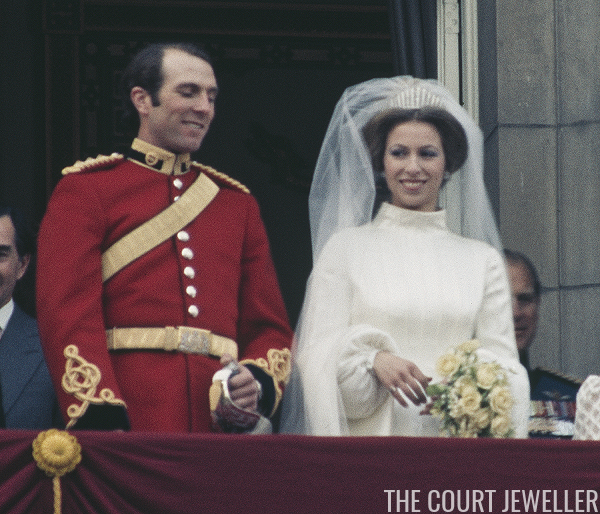
The second Windsor bride to don the tiara was Princess Anne, who wore the fringe at her wedding to Mark Phillips in 1973. Again, it was the Queen Mum who loaned the piece to her granddaughter. In the past, there’s been speculation over why Elizabeth II didn’t wear her wedding tiara regularly after her wedding day; the simplest answer is that it remained in her mother’s jewel collection until the Queen Mother’s death in 2002.
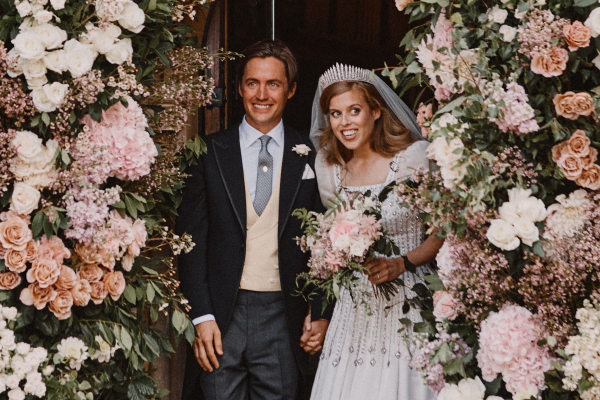
In 2020, another Windsor bride chose to wear the diamond fringe tiara on her wedding day. Princess Beatrice, Elizabeth II’s granddaughter, wore the tiara for her wedding to Edoardo Mapelli Mozzi. She paired the tiara with a vintage dress designed by Sir Norman Hartnell for the Queen in the 1960s.
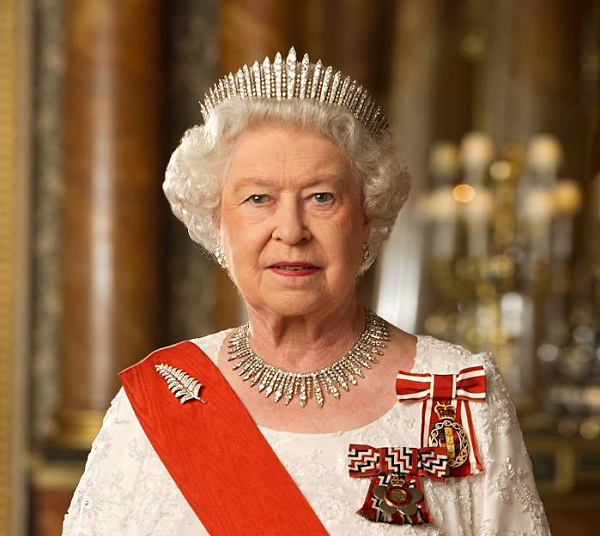
Until her death in 2022, Elizabeth II was the owner of the piece. Now, it belongs to King Charles III. In the last years of her life, the late Queen occasionally wore the fringe at white-tie events and in portraits—notably, in New Zealand’s Diamond Jubilee portrait, in which the tiara was misidentified as (you guessed it) the Hanoverian Fringe. D’oh!
Leave a Reply
You must be logged in to post a comment.