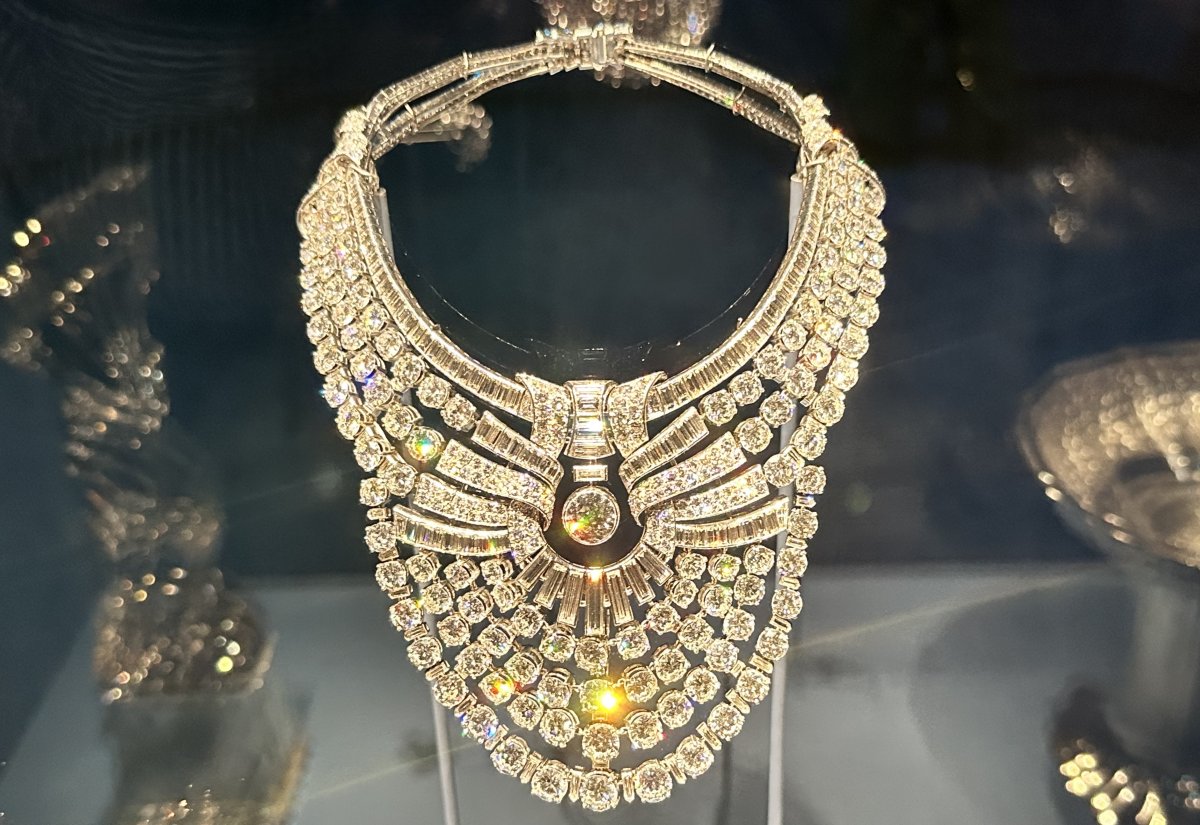
Surprise! We’ve got a second bejeweled field trip this week, thanks to the generosity of another of our wonderful community members. This time, we’re going to marvel at the splendor of Van Cleef & Arpels, on display at a fabulous art museum in Vienna.
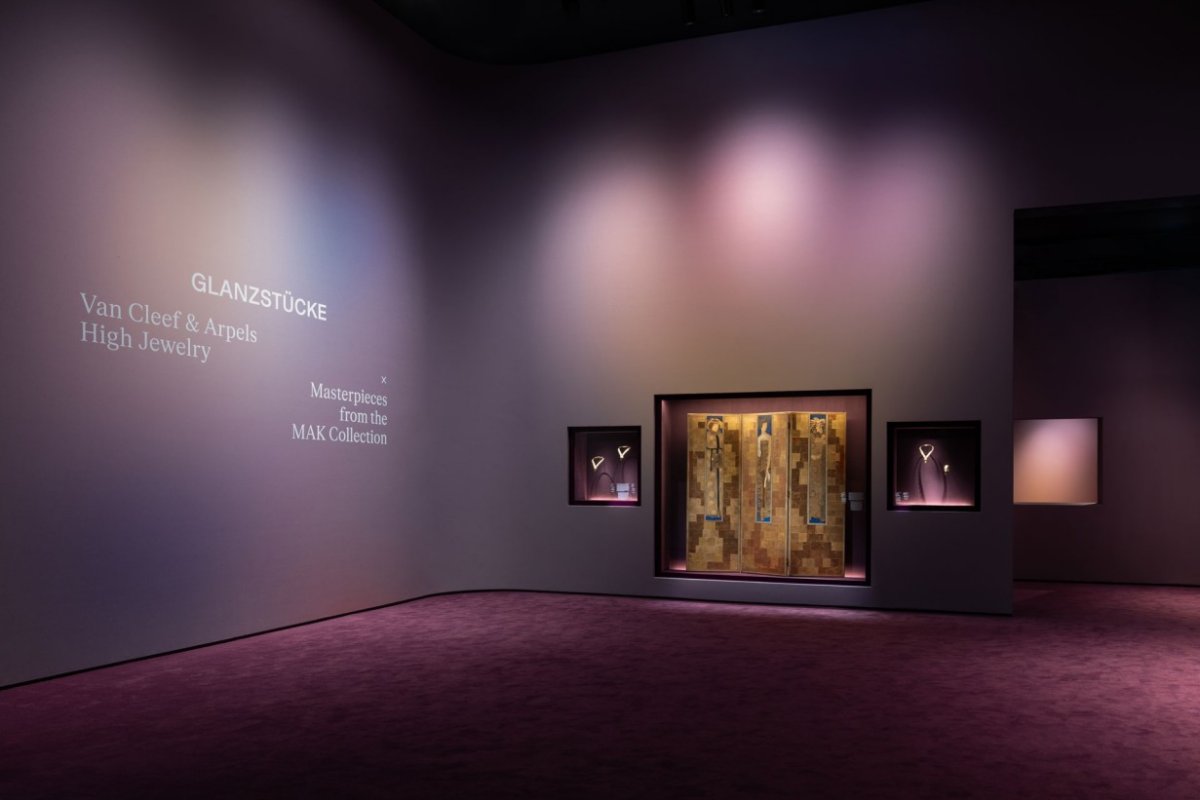
The Museum of Applied Arts in Vienna, better known as MAK, is home this summer to a special exhibition of jewelry from the archival collection of Van Cleef & Arpels. “Glanzstücke: Van Cleef & Arpels High Jewelry × Masterpieces from the MAK Collection,” which opened in June, features objects from the MAK collections presented in conversation with pieces from the iconic jewelry house.
Curated by Alexandrine Maviel-Sonet of Van Cleef & Arpels and MAK’s Anne-Katrin Rossberg, the exhibition presents objects and jewels brought together by “their exceptional craftsmanship, visionary design, and the materials utilized. The pairings also reveal surprising parallels in form, color, and motifs, which often stem from similar sources of inspiration.” For example, you’ll see four of VC&A’s iconic Zip jewels shown above alongside a folding screen designed by the artist Koloman Moser and made in Vienna in 1906.
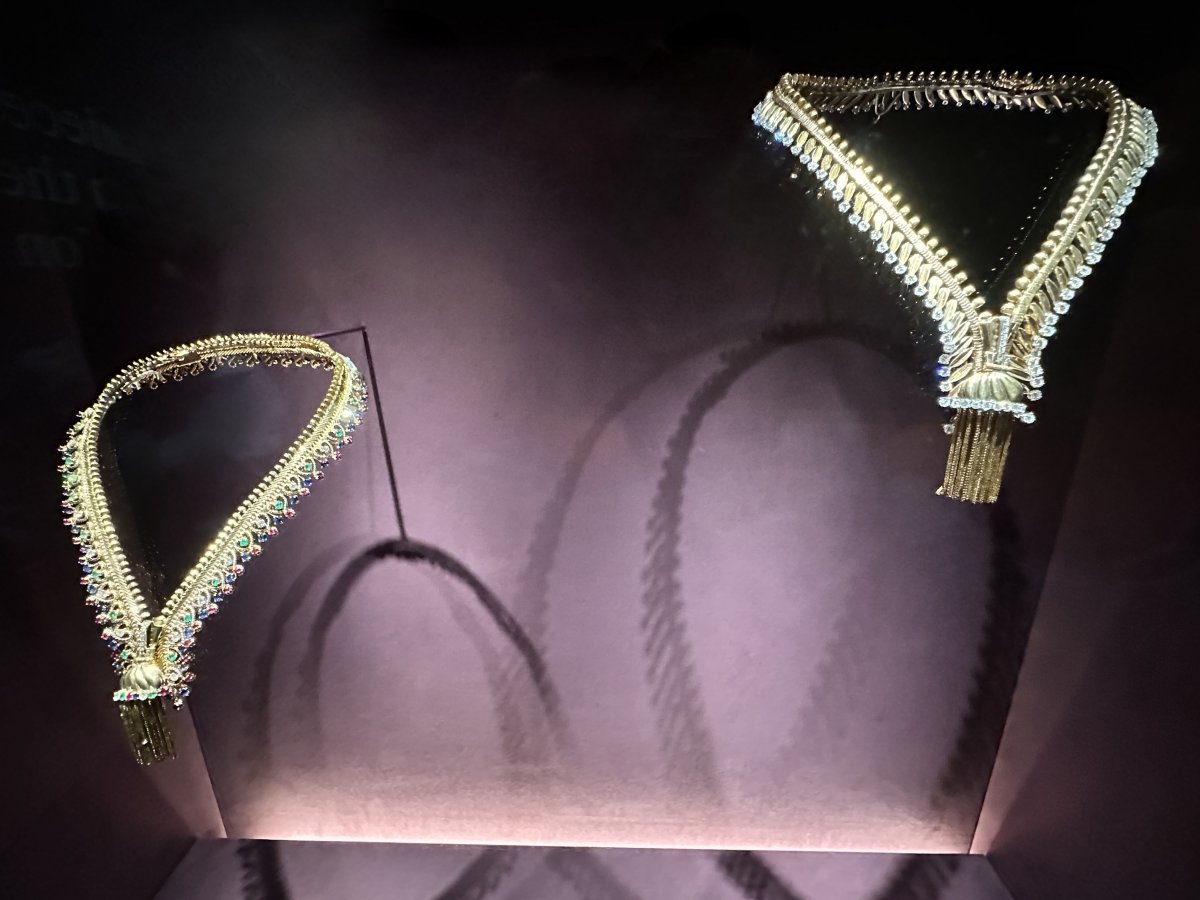
And here’s a close-up of two of those Zip necklaces, provided by the wonderful Toni, who had the chance to see the exhibition in person in July. She emailed me recently to share her photographs, and I just about fell over when I opened the files. I’ve curated a selection of the pieces she shared, with a focus on twentieth-century jewels, thanks to her generous offer to have the pictures published here at TCJ.
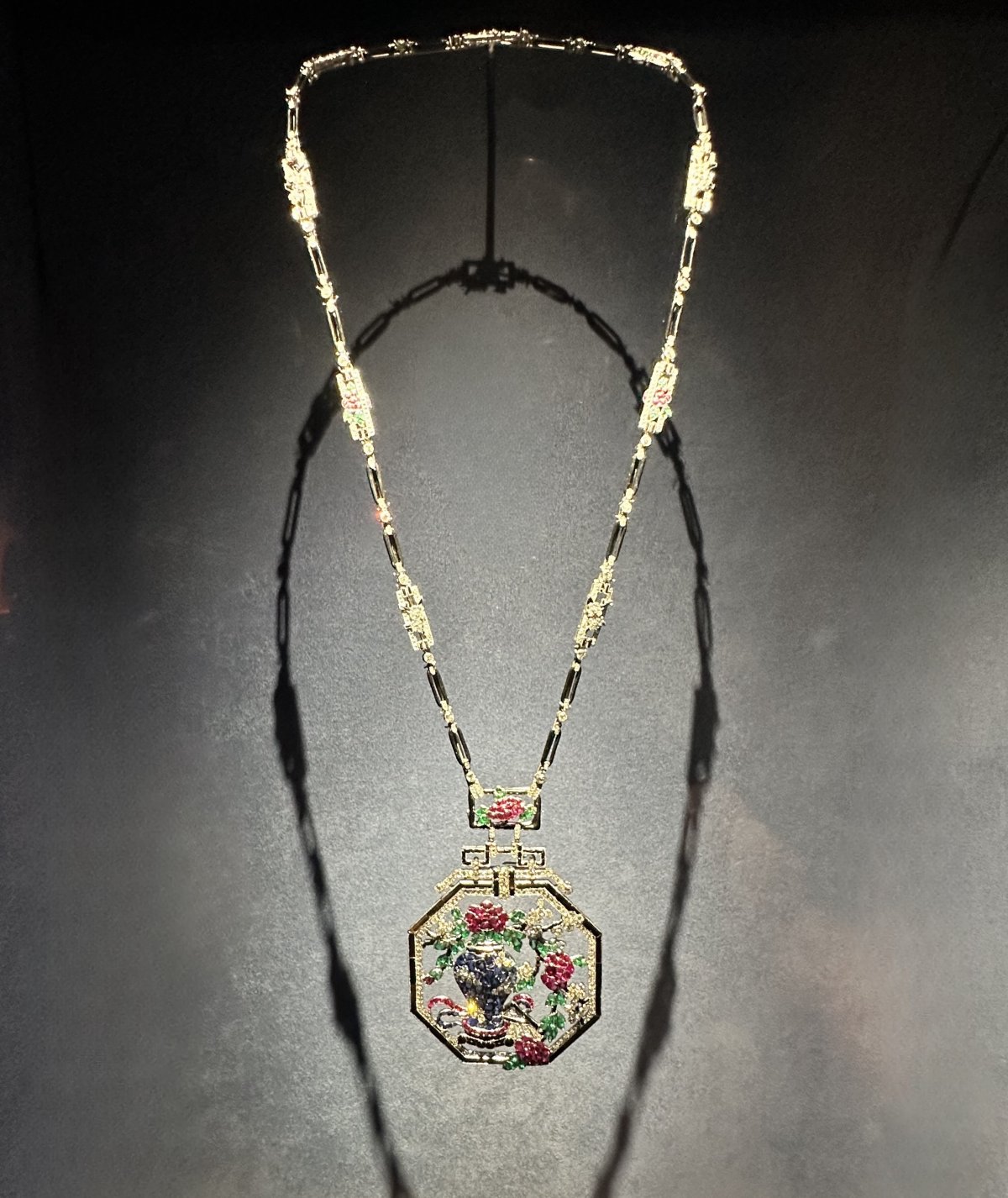
Some of the oldest pieces on display date to the early Art Deco period of a century ago. Here’s a rather spectacular sautoir necklace with a delicate, intricate floral theme, surely inspired by art pieces from Asia. The shape and style, as well as the use of onyx and enamel, make it clear that this piece comes from 1924.
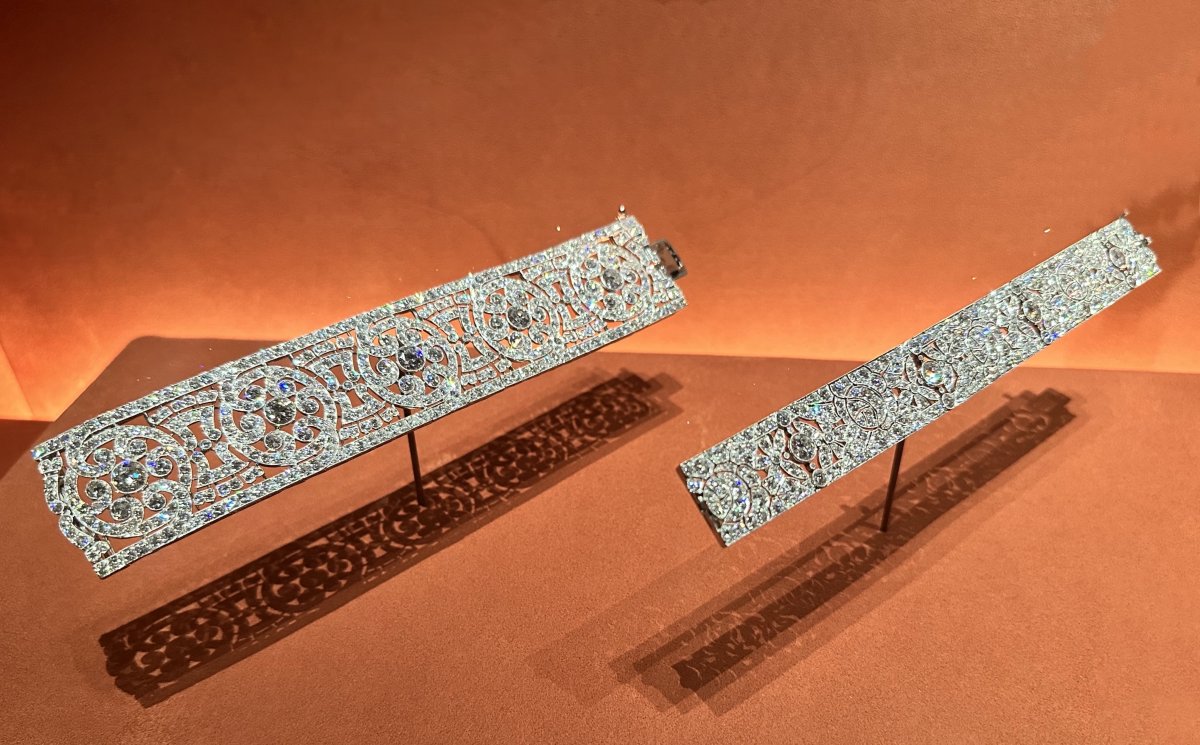
These platinum and diamond bracelets date to the same period: 1922-1925. They look heavy from a distance, but a closer view reveals intricate plaques with swirling circle and scroll designs.
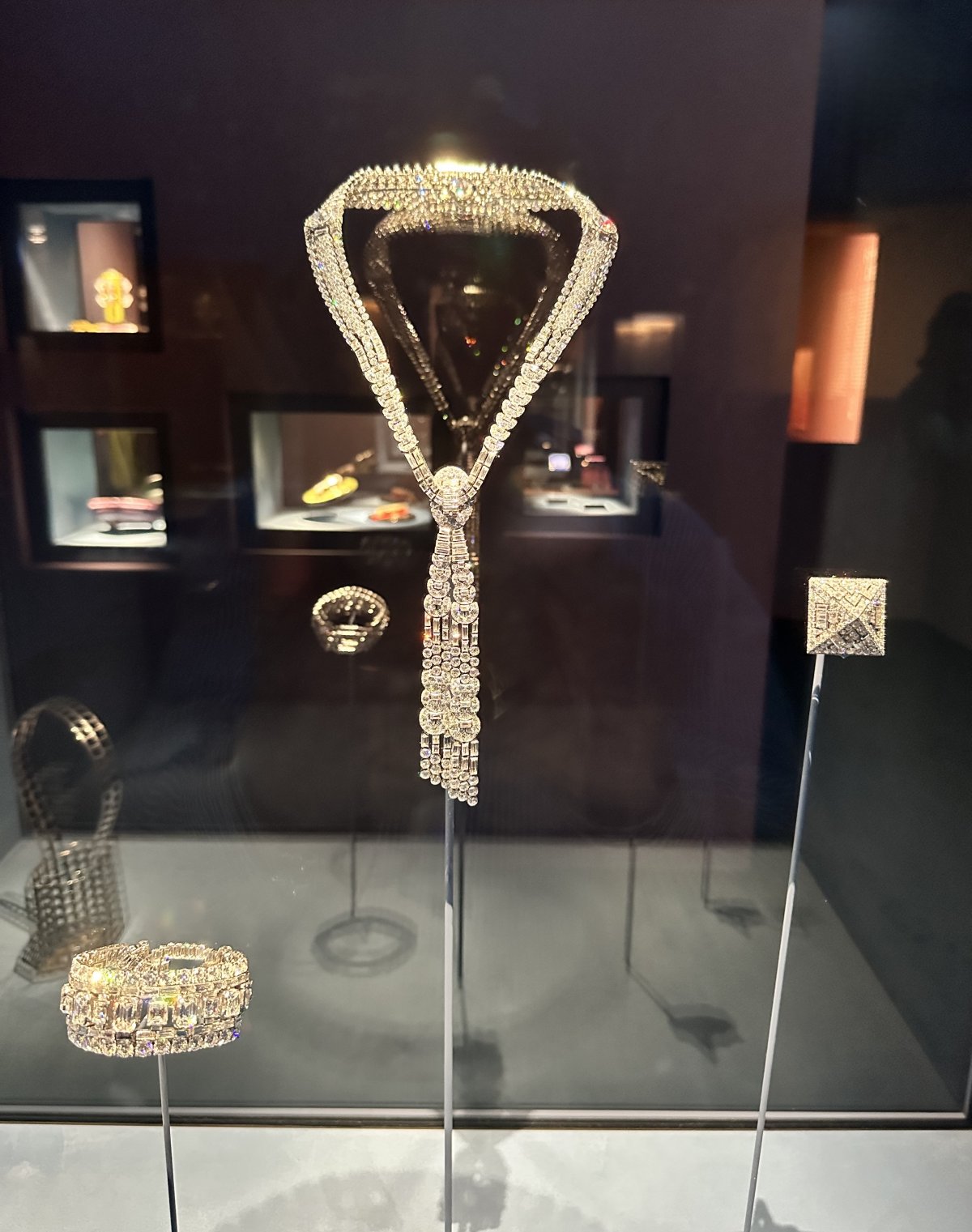
This witty diamond necklace, made in the shape of a necktie, was also made in the 1920s, albeit at the end of the decade. The heavier, more masculine styles that became increasingly popular in the 1930s and 1940s are evident here, in both the necklace and the bracelet and brooch, which both date to 1935.
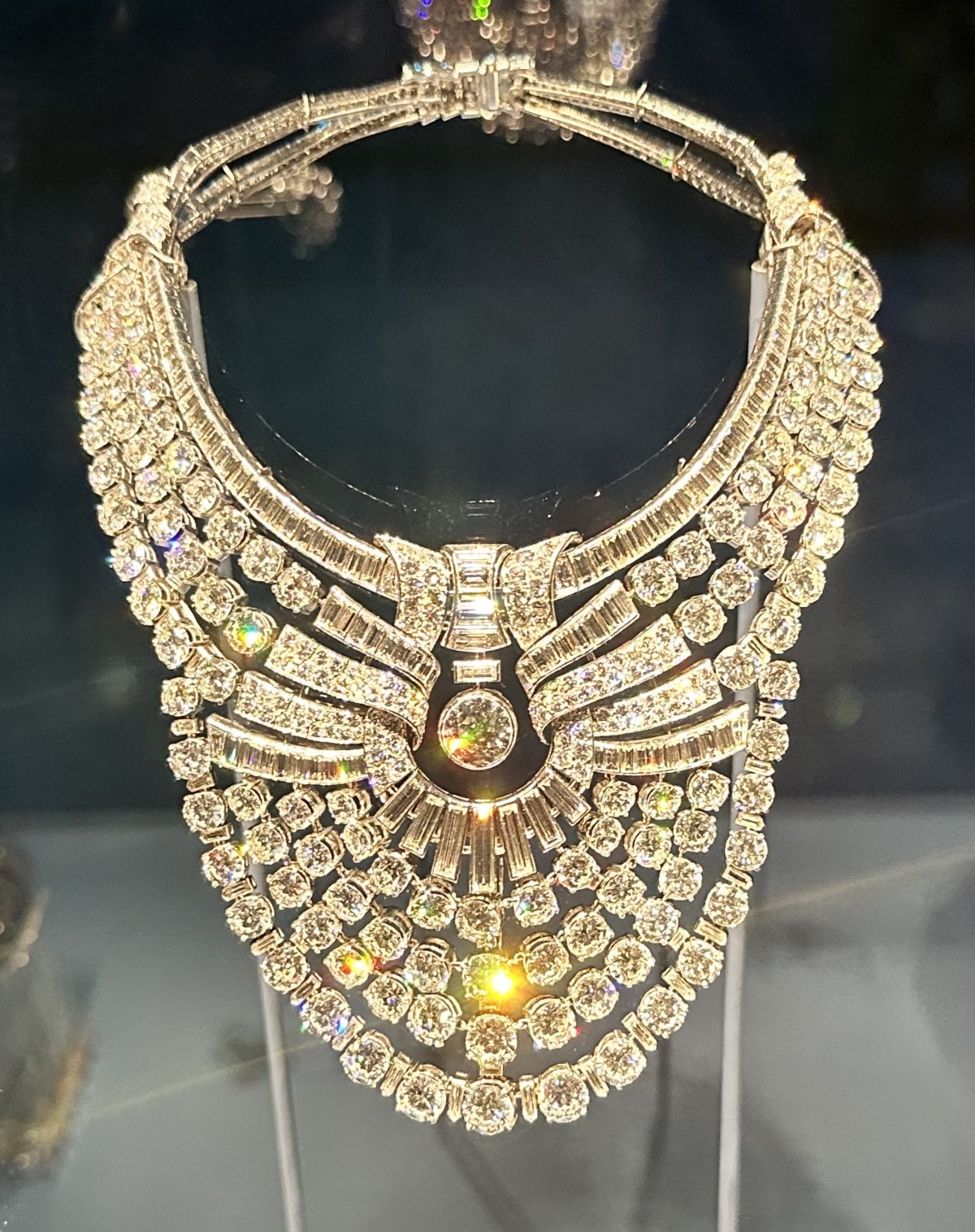
The 1920s and 1930s are also represented by jewels that come from a pair of Egyptian royal women. This stunning bib-style necklace, which is displayed alongside coordinating earrings and a matching clip-style brooch, belonged to Queen Nazli of Egypt. The necklace was made in 1939, during the early years of the reign of her son, King Farouk, to match a stunning 1920s tiara from her collection. She famously wore the parure for the wedding of her daughter, Princess Fawzia, to the Shah of Iran. Nazli sold both pieces at Sotheby’s in 1975.
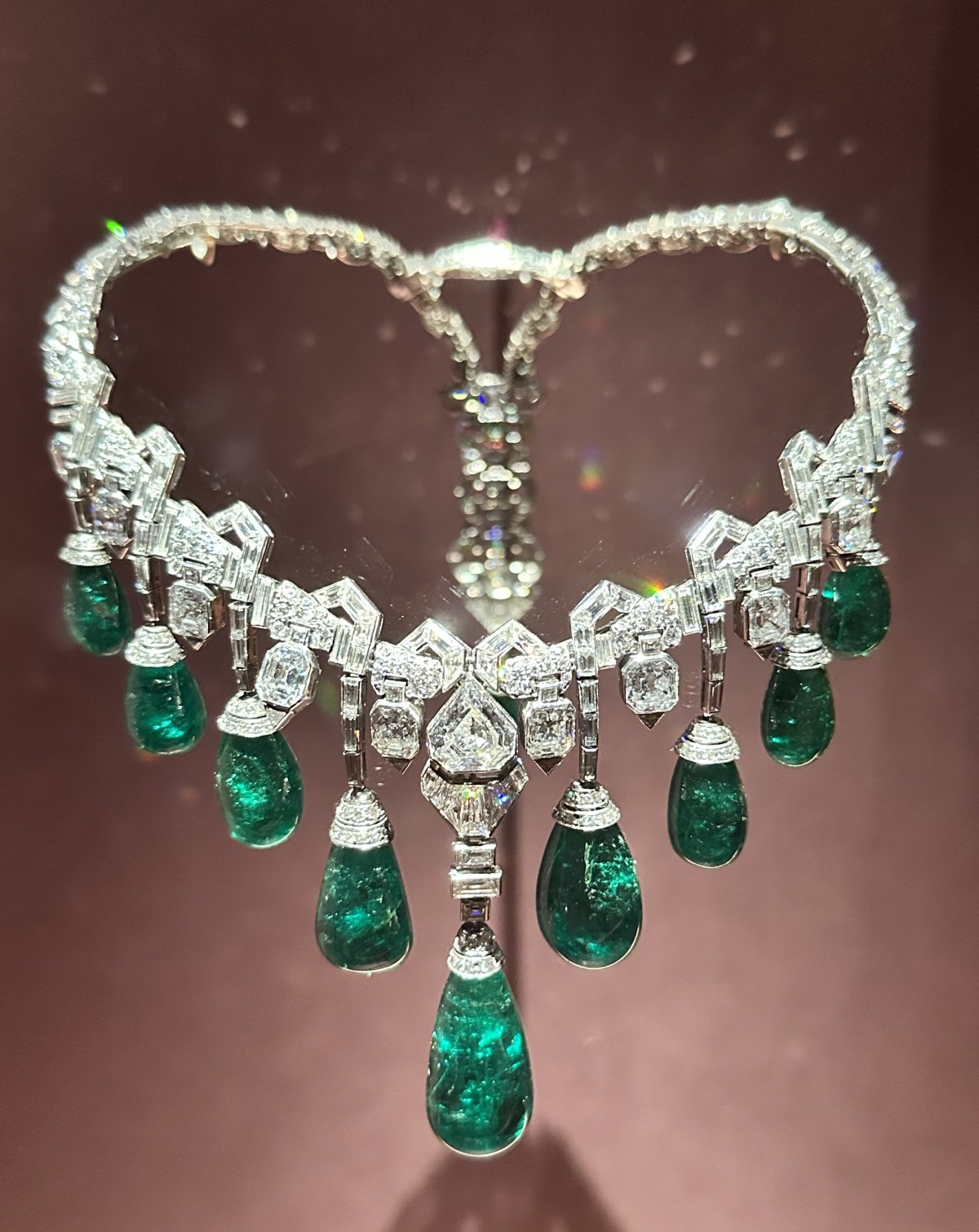
Also on display is this jaw-dropping necklace of diamonds and cabochon emerald drops. It belonged to Queen Nazli’s daughter, Princess Faiza. She left Egypt after the revolution in 1952 and eventually settled in Beverly Hills.
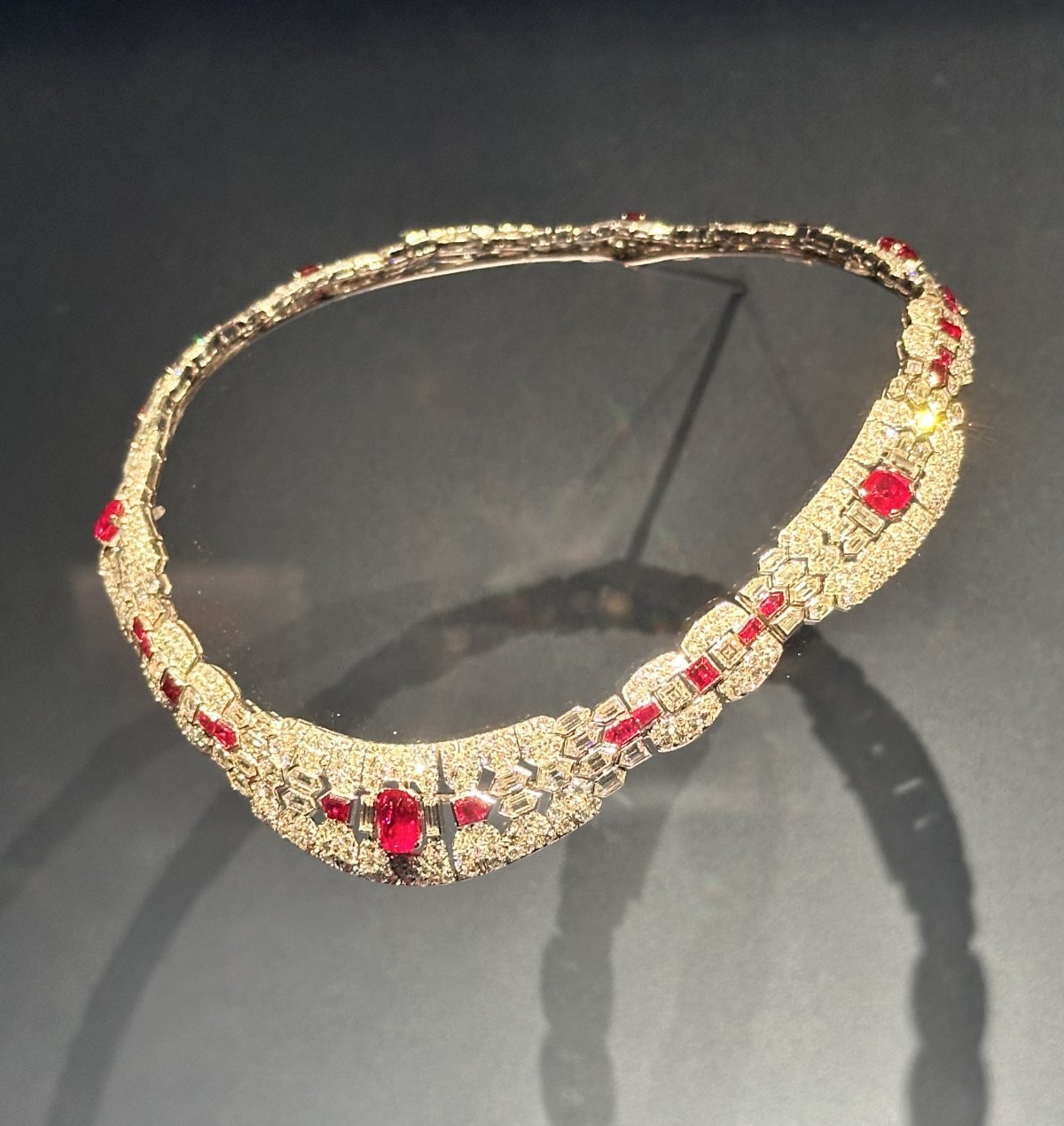
The era is also represented in the exhibition by several pieces of ruby and diamond jewelry, including this classic necklace from 1936.
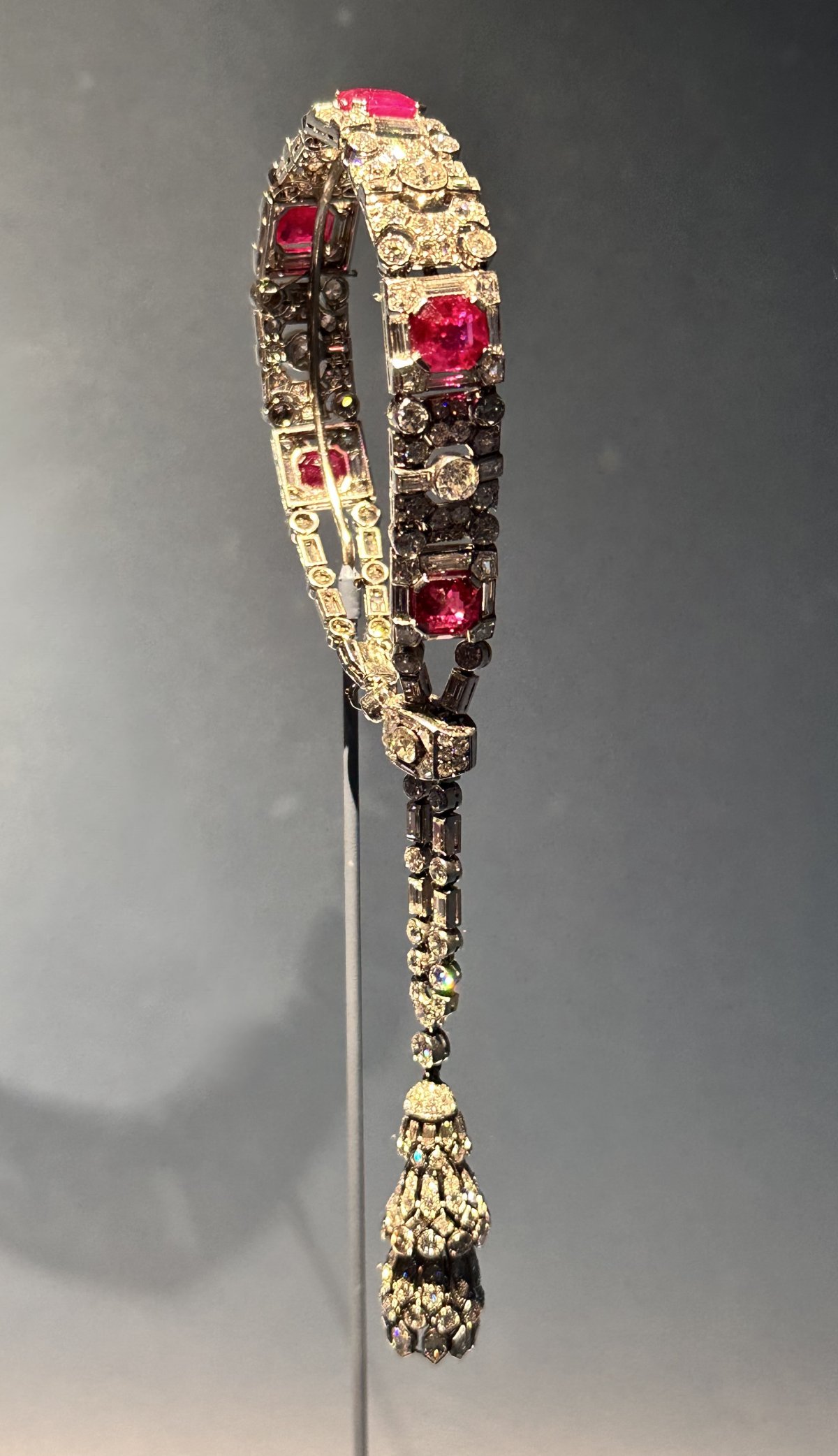
It’s shown alongside this showstopper of a bracelet from 1929. The tassel detail on this ruby and diamond piece is wonderful.
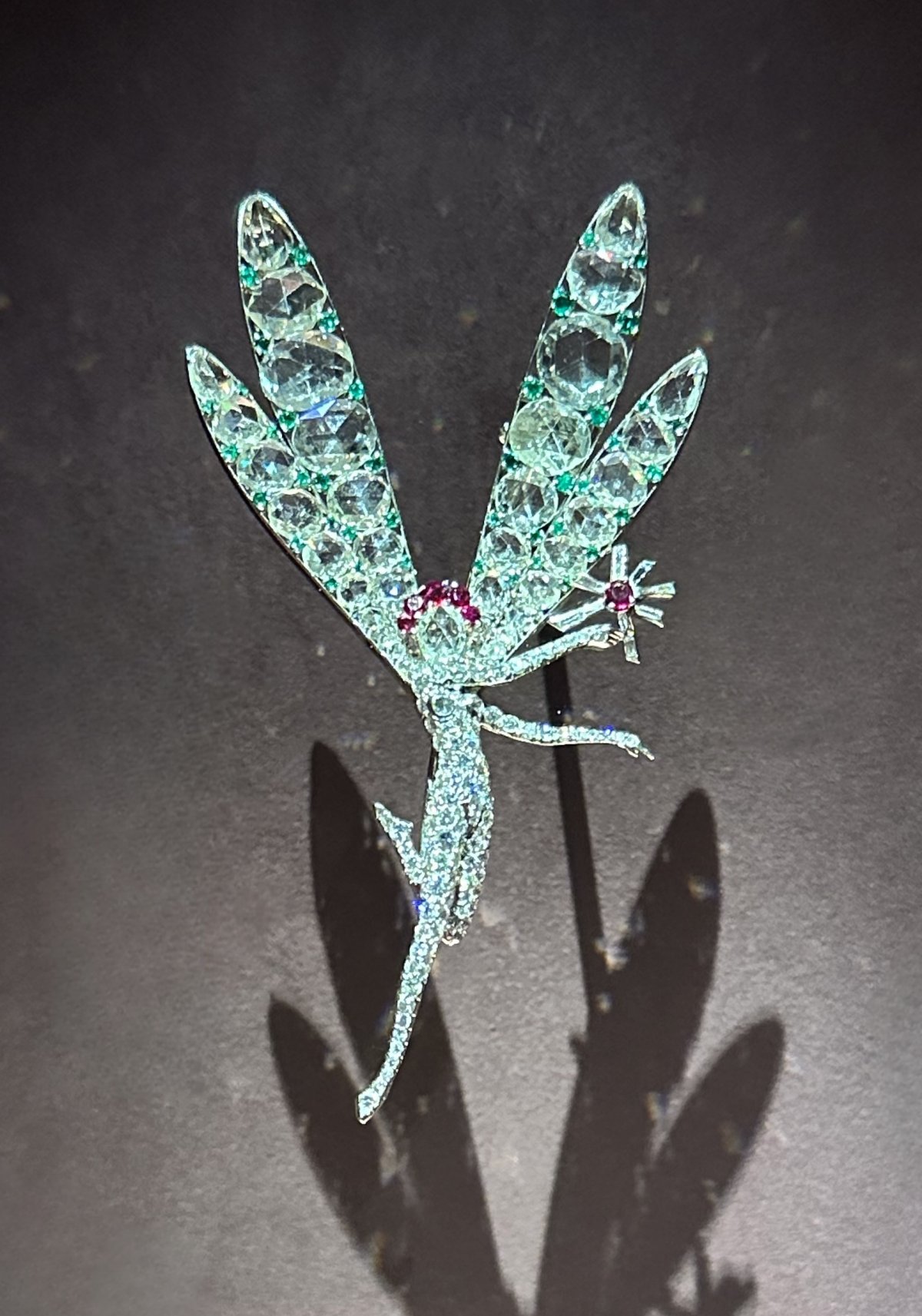
The era of the 1940s is represented by pieces that occupy the far ends of the period’s design spectrum. From 1941, this brooch, called the “Spirit of Beauty,” is the first of a series of fairy clips made by the company. The rather twee little jewel, set with diamonds, rubies, and emeralds, was purchased by the socialite and jewelry collector Barbara Hutton as a gift for a friend.
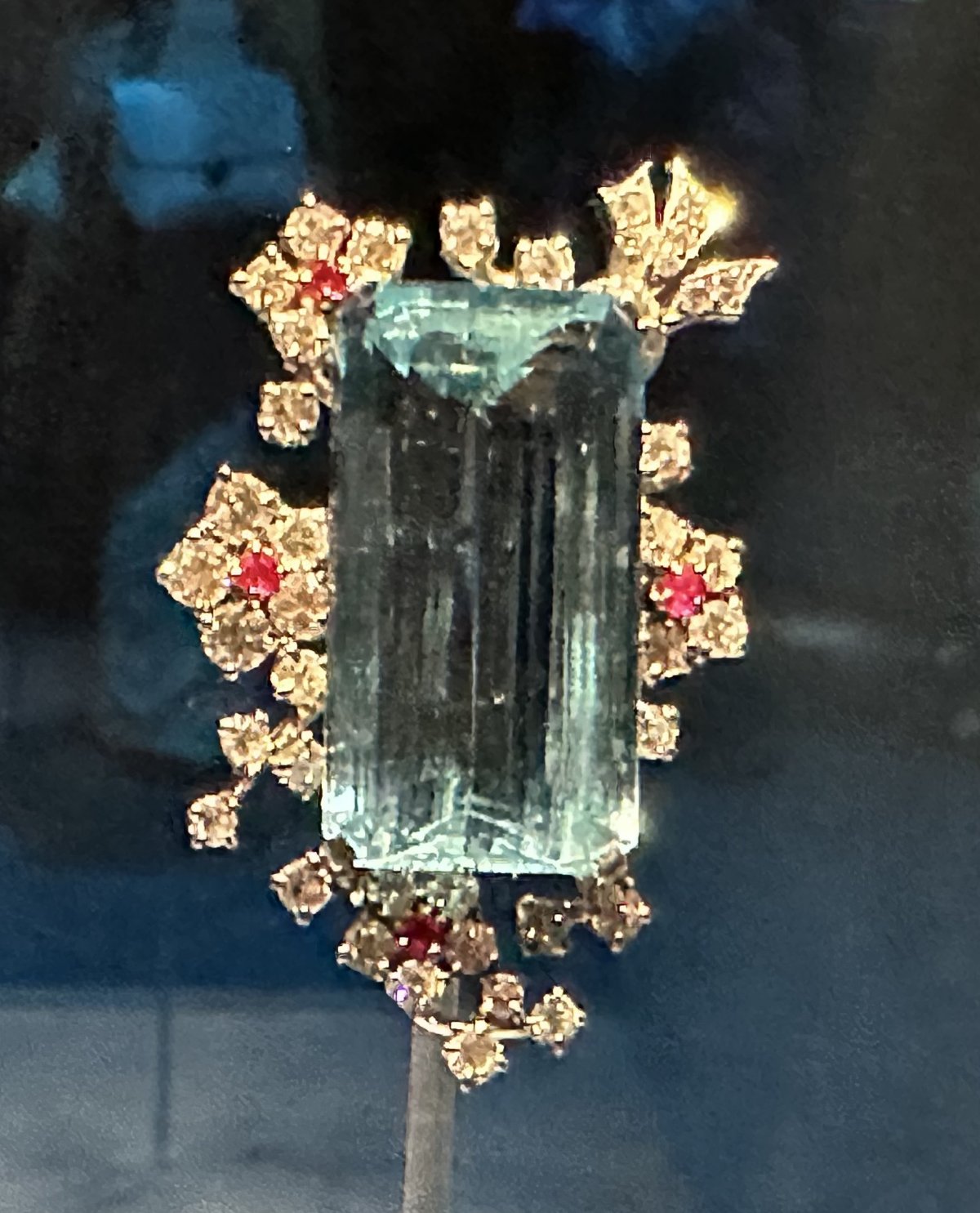
Another brooch demonstrates the bolder design motifs of the decade: this extravagant rectangular aquamarine, whose hardness is relieved slightly by a floral border of diamonds and rubies.
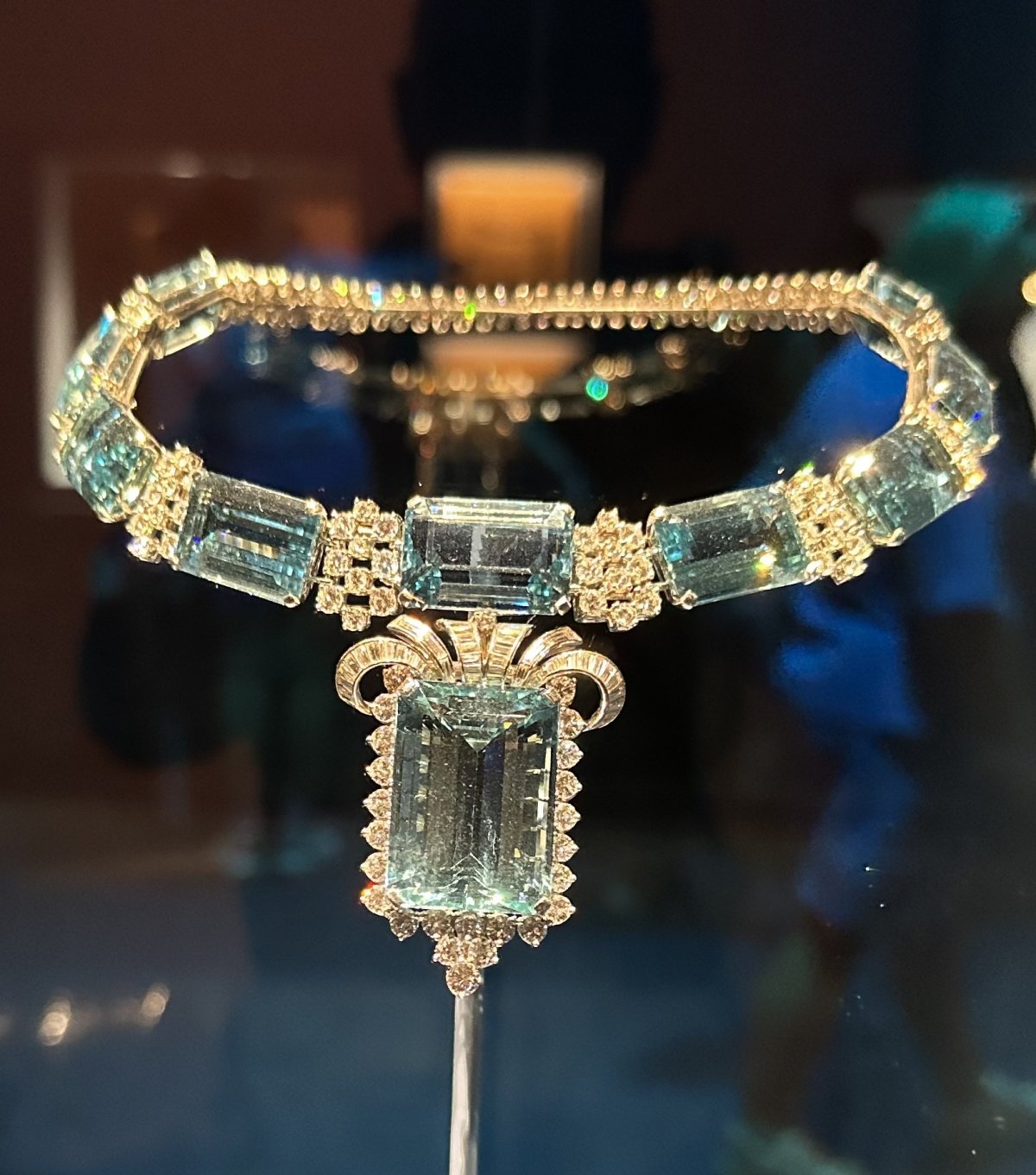
The brooch is displayed near another aquamarine piece, this time from the 1950s. I already know what you’re all thinking, because I’m thinking it too: this 1955 necklace is clearly a cousin of the original Brazilian aquamarine necklace owned by the late Queen Elizabeth II. The Queen’s necklace was made during the same era, presented to her by the Brazilian government as a coronation gift in 1953. The necklace displayed here, like the Queen’s, features a detachable pendant. It can also be converted to be worn as a bracelet.
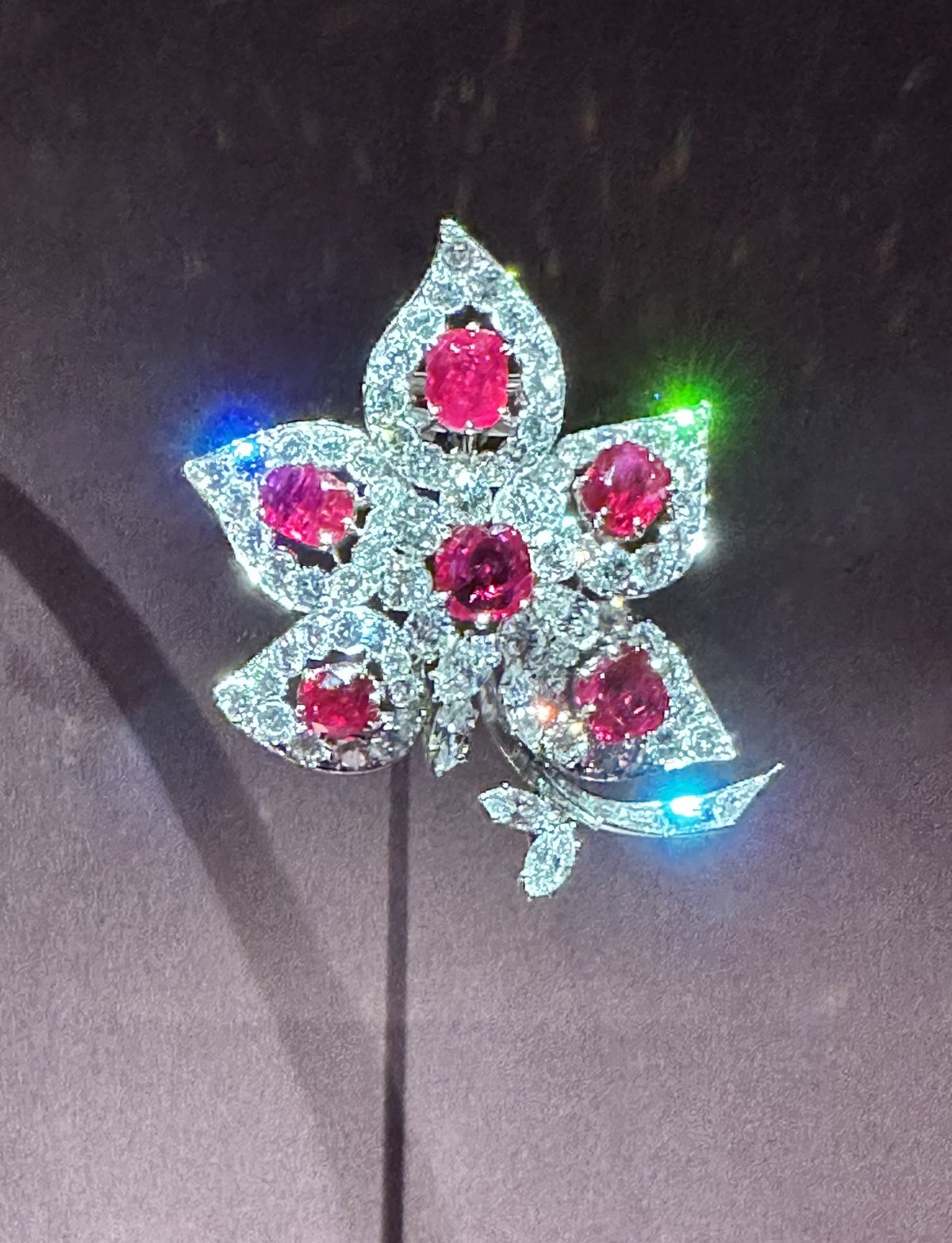
The 1950s and 1960s are also typified by more jewels included in the exhibition, including this diamond and ruby leaf brooch that belonged to the famous opera singer Maria Callas.
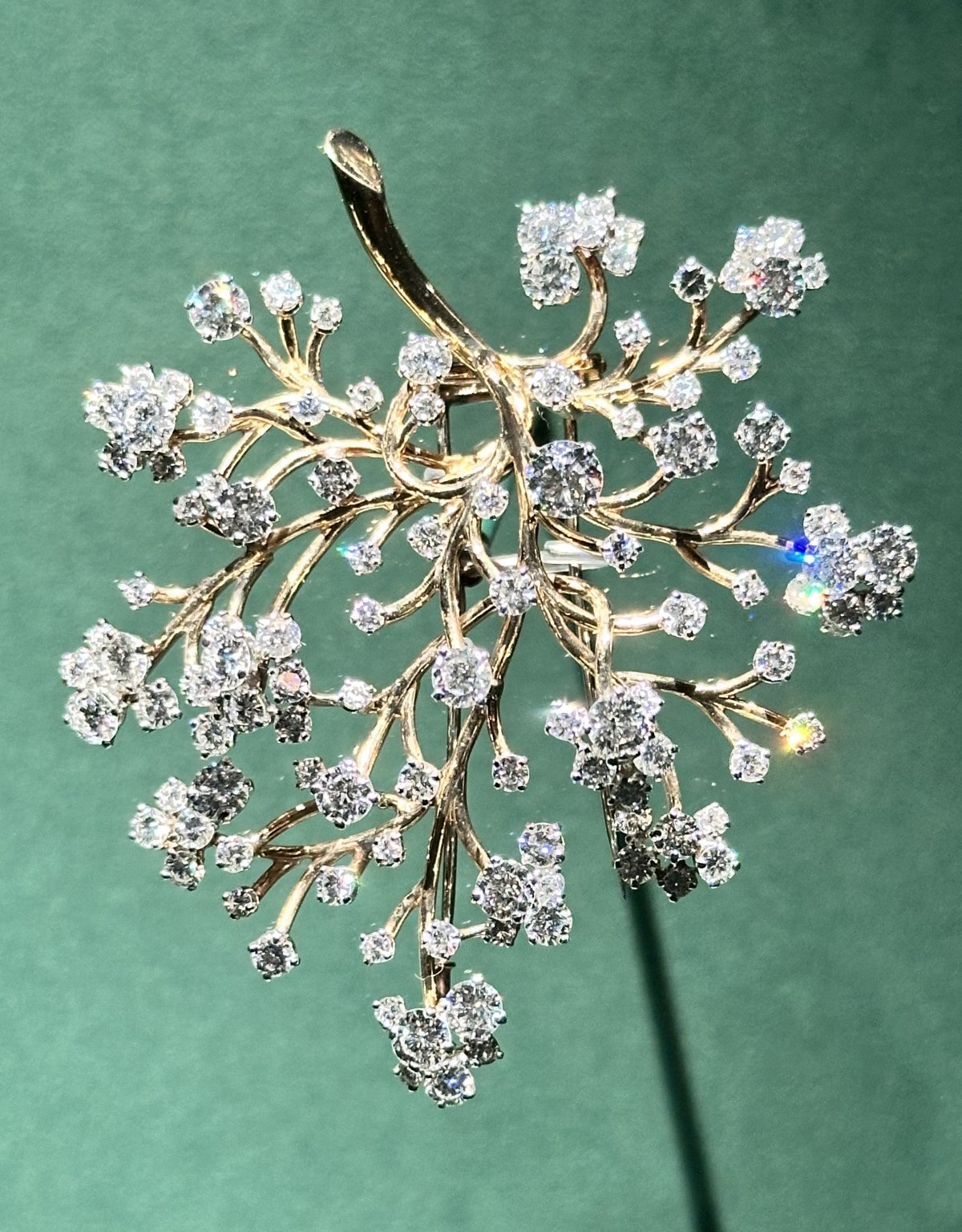
This diamond fern brooch, made just a few years earlier, shows the more delicate sensibilities of the 1950s compared with the increasingly bold and bright ’60s.
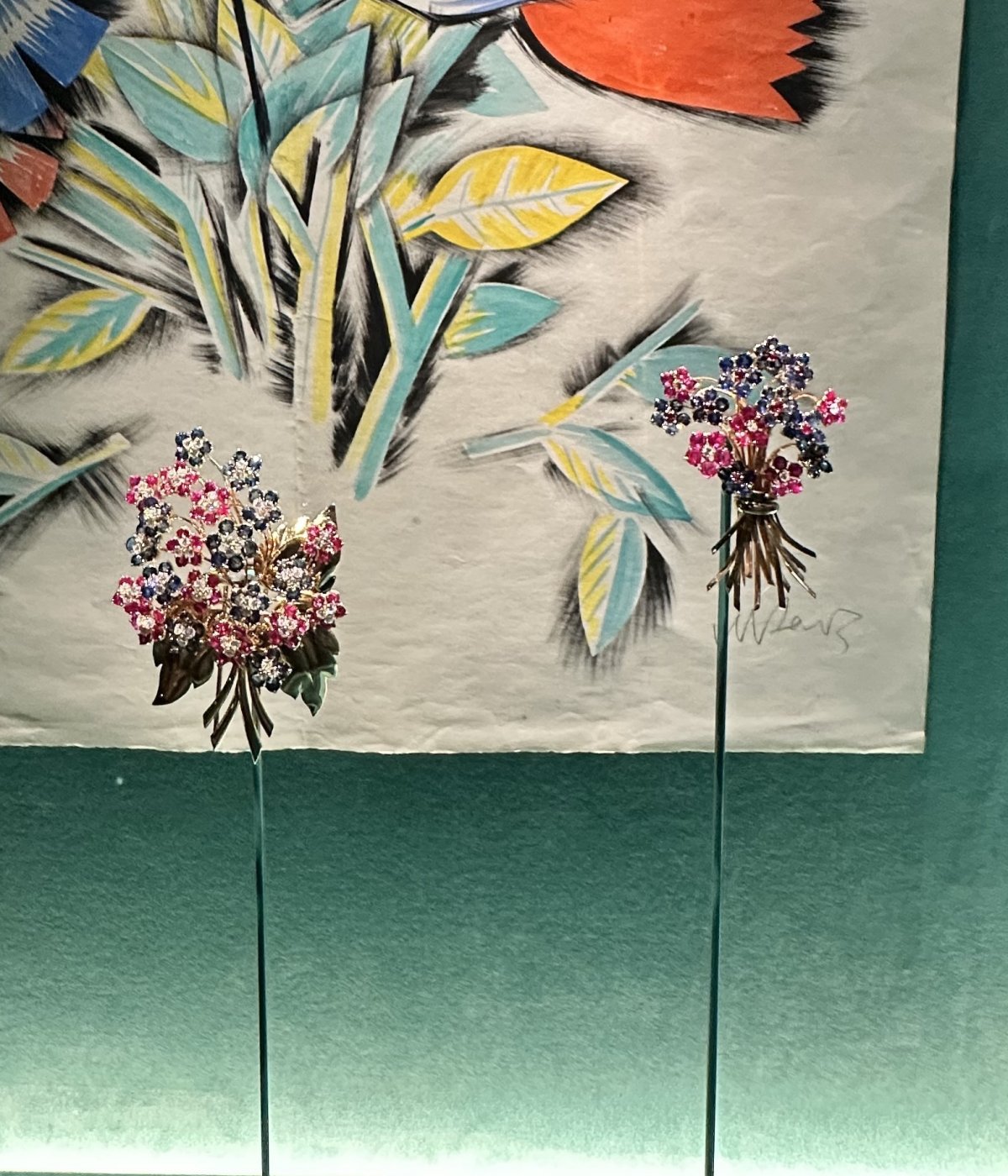
The fern is part of an interesting set of floral jewels on display. Also shown are these brooches from the firm’s Hawaii collection, which made its debut in 1938. These two examples, shown beside a vibrant illustration, are set with rubies, sapphires, and diamonds.
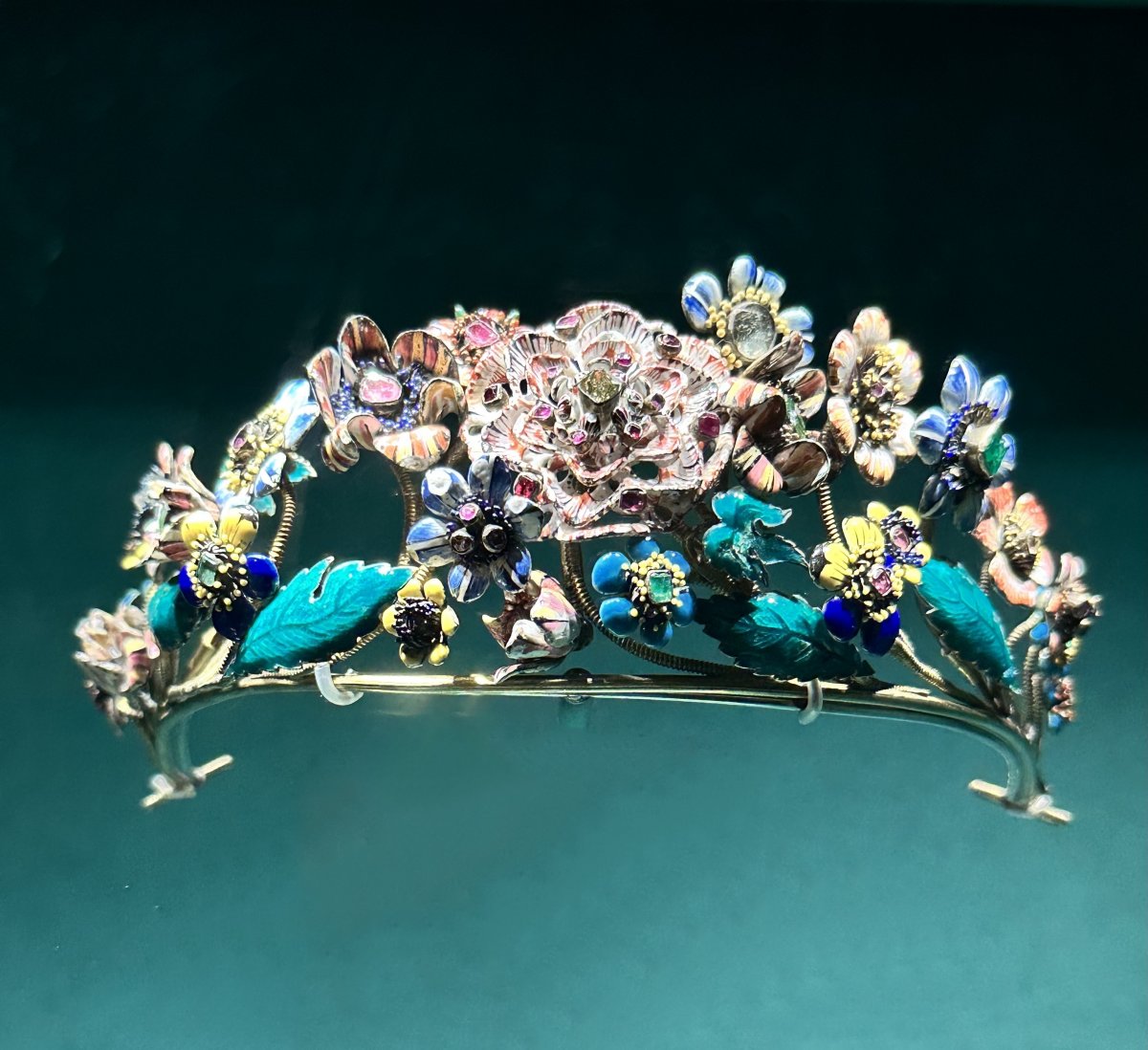
They’re shown in conversation with a fascinating jewelry piece from the MAK collection: a silver-gilt floral diadem, decorated with enamel, diamonds, emeralds, rubies, and garnets. Astonishingly, the museum dates the German-made piece to 1640 (!). I’m surprised by (and a little skeptical of) that date. The object notes from MAK also state that the jewel entered the museum’s collection in 1896.
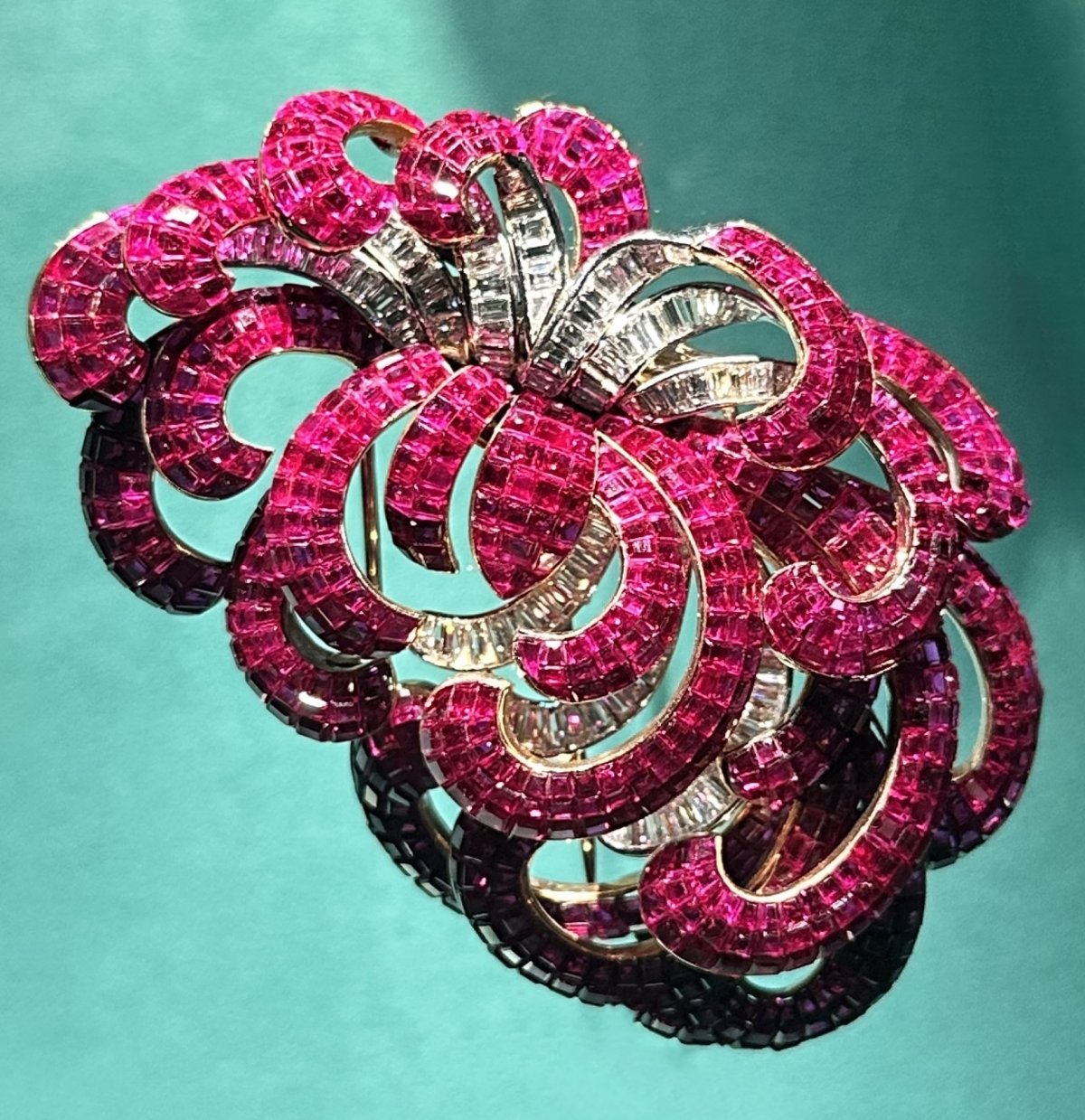
There are more floral jewels on display as well, including one featuring Van Cleef’s most iconic jewelry innovation: the mystery set. This stunning chrysanthemum brooch showcases curling, mystery-set rubies and diamonds.
The mystery set was far more than a gimmick. Indeed, the firm viewed it as proprietary technology. On their website, VC&A note, “On December 2, 1933, Van Cleef & Arpels registered a patent under the heading: ‘Method for mounting precious stones.’ This document stated that the invention ‘consisted of mounting stones so that only the stone was visible, by concealing the material that served as its mount.’ However, this initial patent did not enable ‘the stones to be placed in keeping with complex curved lines,’ as was the case for the Chrysanthemum clip, which is why, on February 13, 1936, the Maison registered a new patent aiming to perfect the earlier one.”
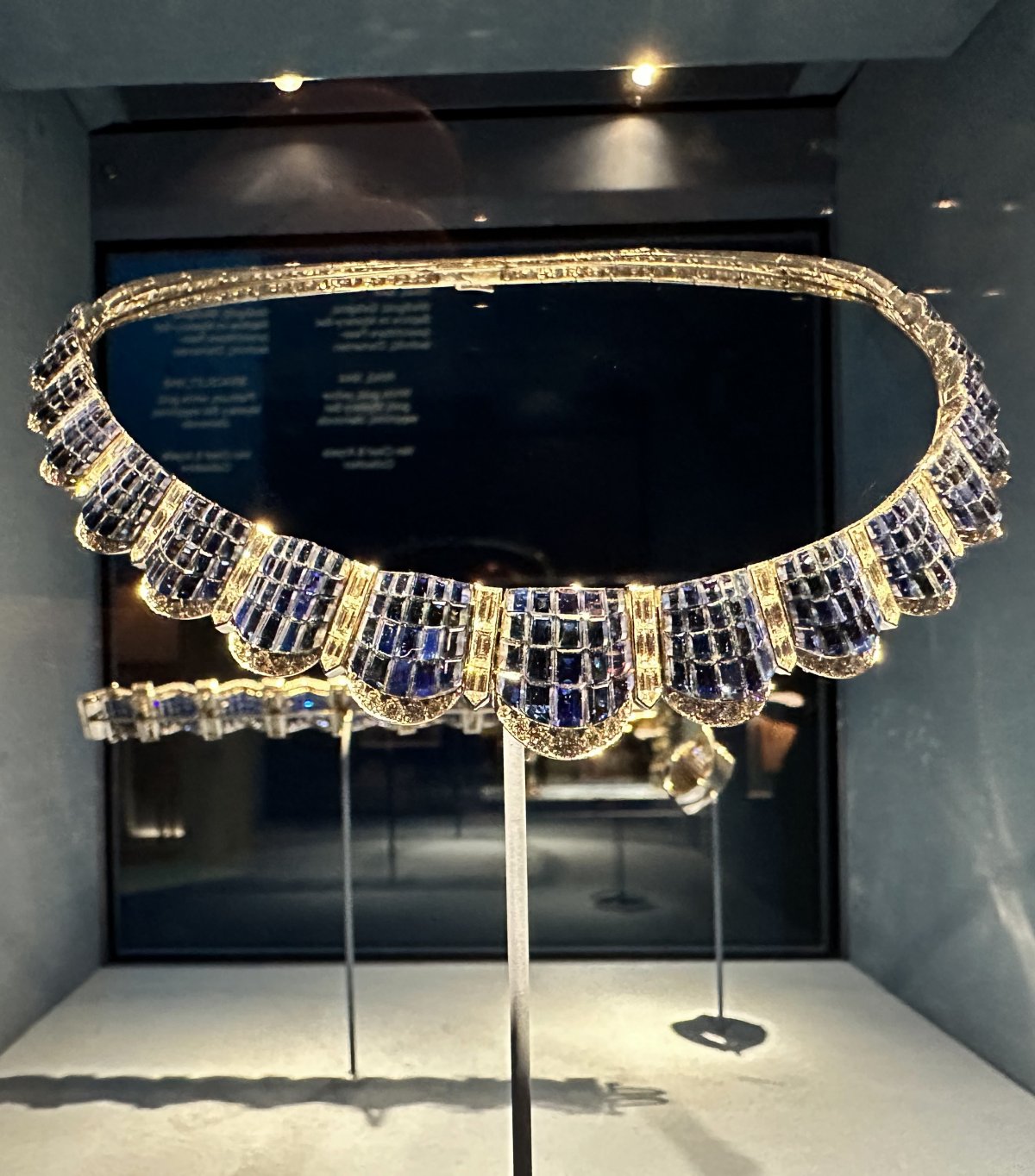
The mystery set has been a hallmark of Van Cleef & Arpels jewelry ever since. Here, also included in the MAK exhibition, is a necklace from the company’s Everest collection. It was made in 1983, fifty years after the mystery set technology was originally patented.
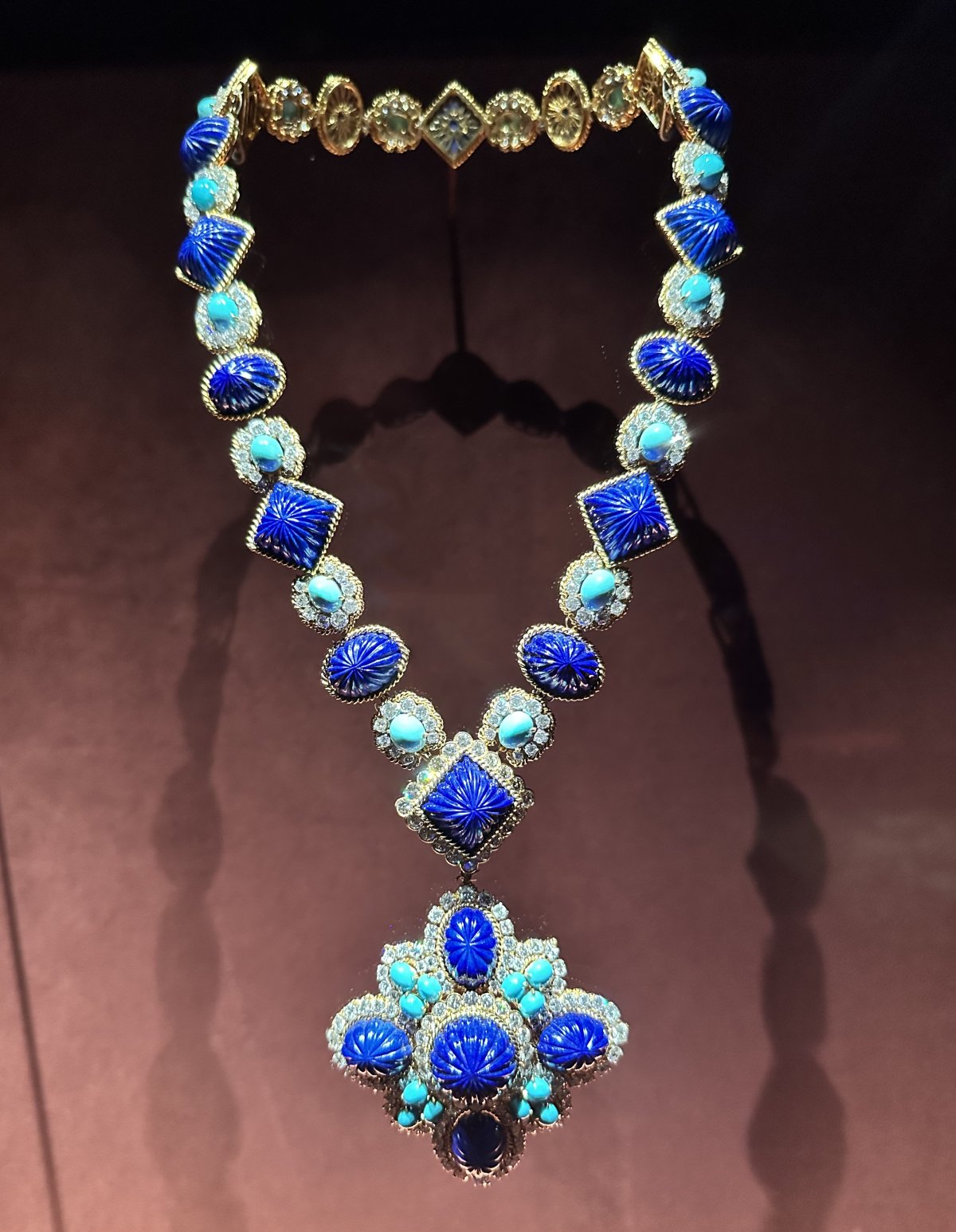
Jewels from the second half of the century show VC&A trying to keep up with increasingly casual times while still producing masterpieces of jewelry art. Here’s a fascinating sautoir set with carved lapis lazuli, turquoises, and diamonds—groovy enough for a ’70s wearer, but still splendid enough to be considered high jewelry.
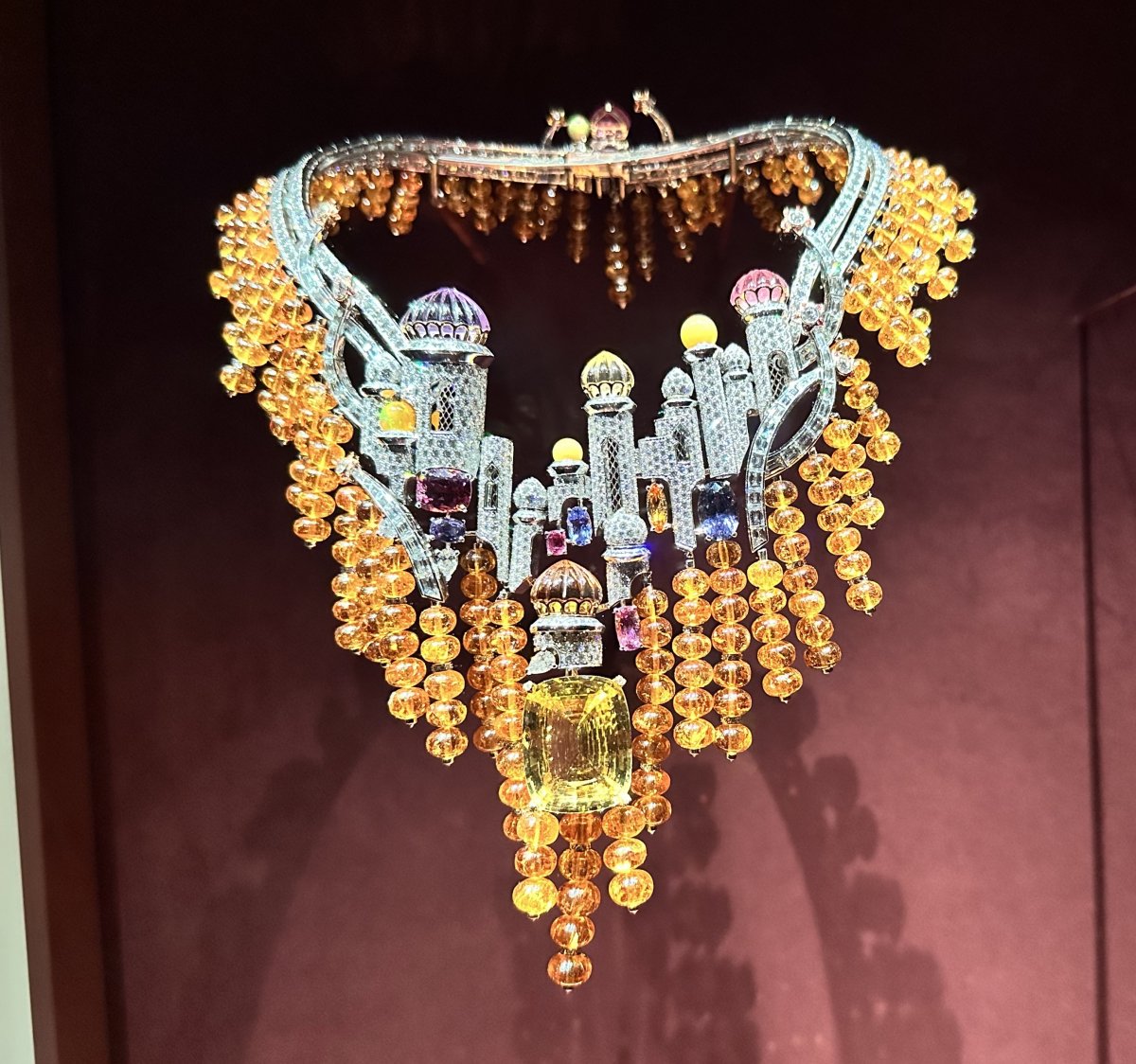
And there are plenty of pieces from today’s Van Cleef & Arpels included in the show as well. The one that captured my attention most strongly was this unusual necklace, made in 2011 as part of the Izmir Set. The jewel is rather literal, with architectural designs reflecting old Turkish buildings. The exhibition explains that the necklace and its accompanying pieces were inspired by a masquerade ball thrown by Alexis, Baron de Redé at the Hotel Lambert in Paris in 1969. (VC&A also made jewels inspired by four more iconic balls, including Truman Capote’s 1966 Black and White Ball and Nicholas II’s grand winter Romanov ball of 1903.) The large stone nestled in the necklace’s spessartite garnet beads is a 50.79-carat yellow sapphire.
Please join me in giving a huge thanks to Toni for bringing us along with her on her visit to the Van Cleef & Arpels exhibition at the MAK. As I said on Tuesday, I’m so grateful to all of you who allow us to travel the world with you!
Leave a Reply
You must be logged in to post a comment.