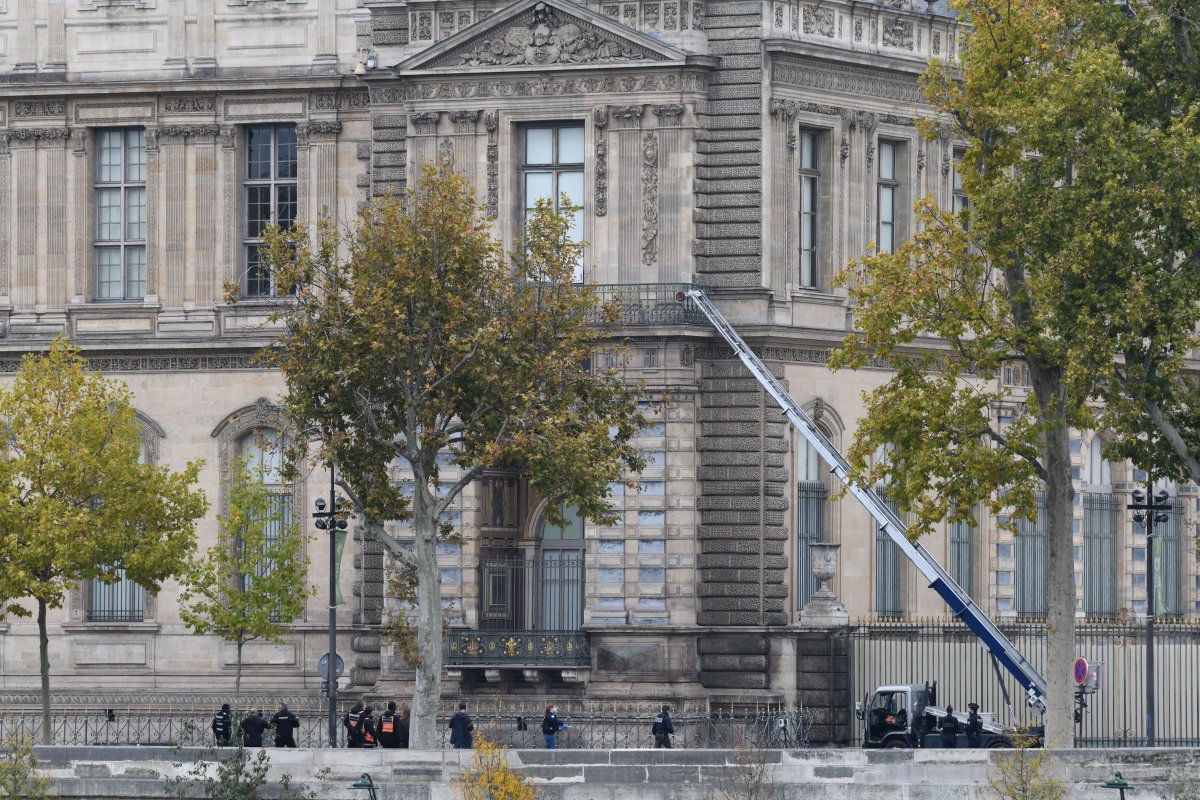
In a brazen heist, thieves managed to get away with several pieces of extremely important historical jewelry from the Louvre Museum in Paris this morning. While details about the theft are still coming in, here’s a look at what we know about the crime so far—and the priceless jewels that have been taken.
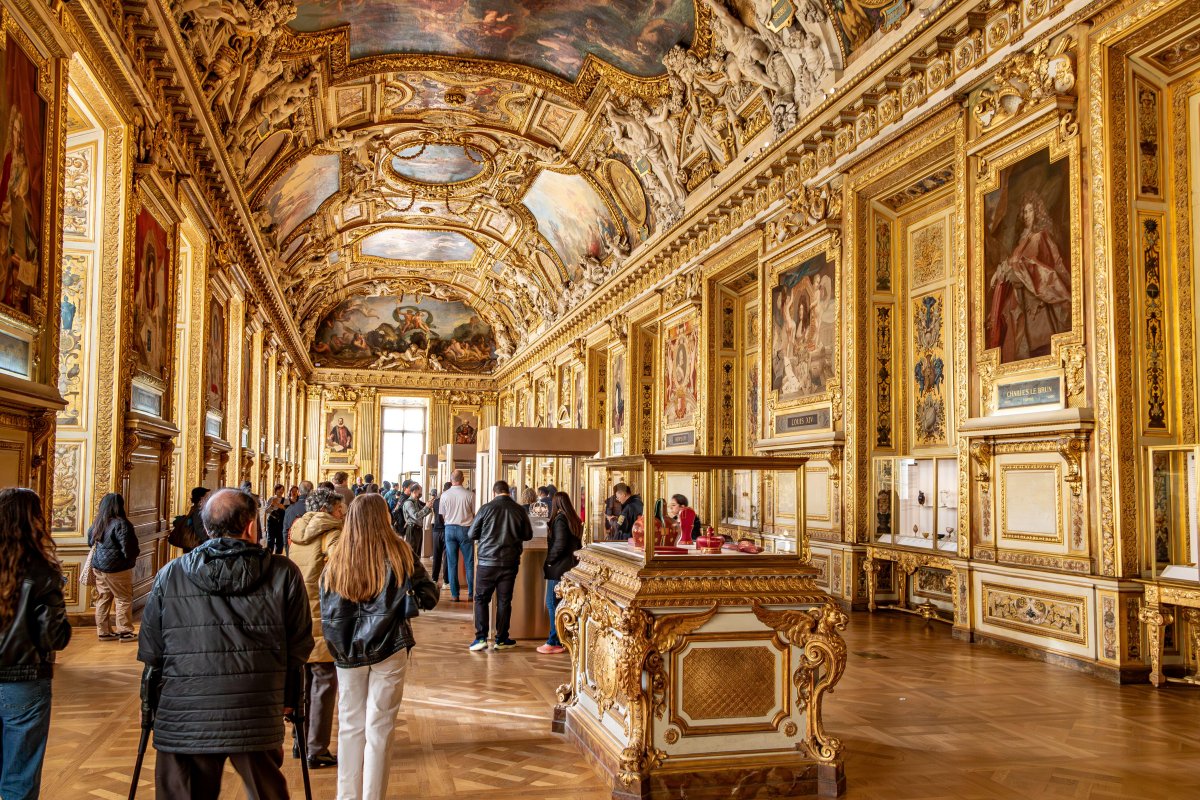
Shortly after the opening of the Louvre Museum on Sunday morning, several suspects entered the museum’s famed Galerie d’Apollon and stole numerous pieces of important historical jewelry owned by Empresses, Queens, and Princesses of France. The theft took place over the course of seven minutes around 9:30 AM local time. Three or four suspects, described by officials as professional thieves, accessed the gallery via a truck and a construction lift placed outside an exterior window.
The suspects used an angle grinder to break a window and enter the room. Inside the gallery, jewels are arranged in a series of glass cases placed in a row down the center of the room. The largest cases are new, having been made during renovations to the space in 2019. (You can see the contrast between the modern and antique display cases in this photograph of the room, taken in 2023.) French interior minister Laurent Nuñez told reporters that the suspects used the angle grinder to break the glass of two of the large cases, apparently the ones closest to the window at the end of the room.
The team of burglars retrieved pieces of jewelry from the cases and quickly fled the scene. They left behind a slew of items, including a pair of angle grinders, a blowtorch, and a walkie-talkie. Also discovered on the ground at the crime scene was one of the stolen jewels: a magnificent crown dating to the reign of Emperor Napoléon III. The crown, which had been housed in one of the cases closest to the window, is reported to have suffered damage.
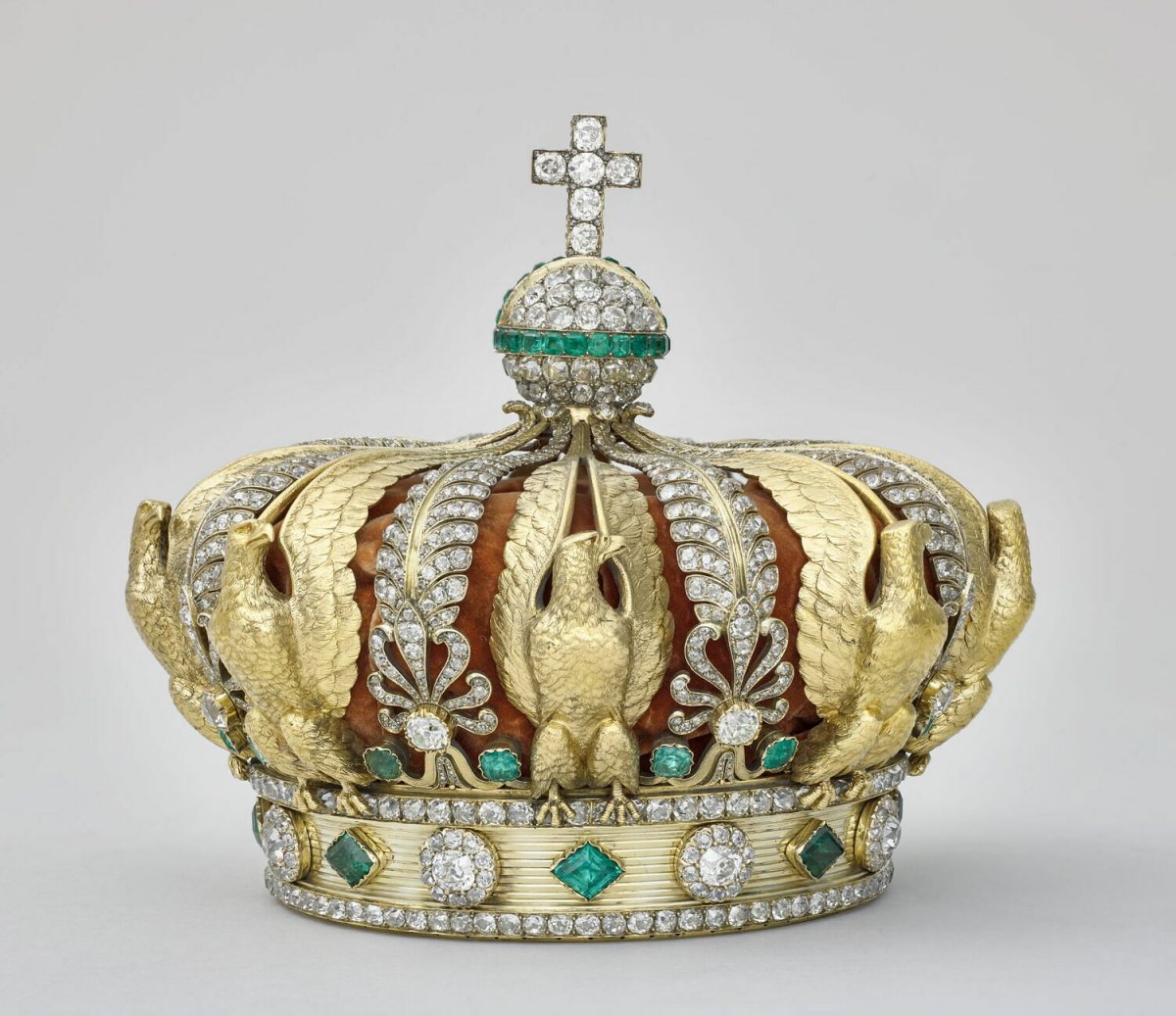
The crown was made in 1855 by the imperial crown jeweler, Alexandre-Gabriel Lemonnier. The jewel, described as Empress Eugénie’s crown, was never actually used in a coronation. Instead, it was made specifically to be displayed at the Universal Exhibition in Paris alongside a similar crown made for Emperor Napoléon. Eugénie’s crown is made of gold and set with thousands of diamonds, plus 56 emeralds, which were Eugénie’s favorite gemstone. The Louvre acquired the crown in 1988.
In total, it’s been reported that nine pieces of jewelry were taken from the glass cases at the Louvre on Sunday morning. Three of these—Empress Eugénie’s crown, as well as two of her diamond brooches—are confirmed to have been recovered. Reporting for Le Parisien, Jean-Michel Décugis listed the stolen items as a parure, a necklace, a pair of earrings, a brooch, and two crowns (coronnes), including Eugénie’s recovered crown.
The Ministry of Culture later offered a specific roster of the missing jewels. Along with Empress Eugénie’s crown, the thieves stole the tiara, necklace, and earrings from Queen Marie-Amélie’s sapphire parure; the emerald necklace and earrings that belonged to Empress Marie Louise; the diamond reliquary brooch; Empress Eugénie’s diamond bow ornament; and Eugénie’s diamond and pearl tiara.
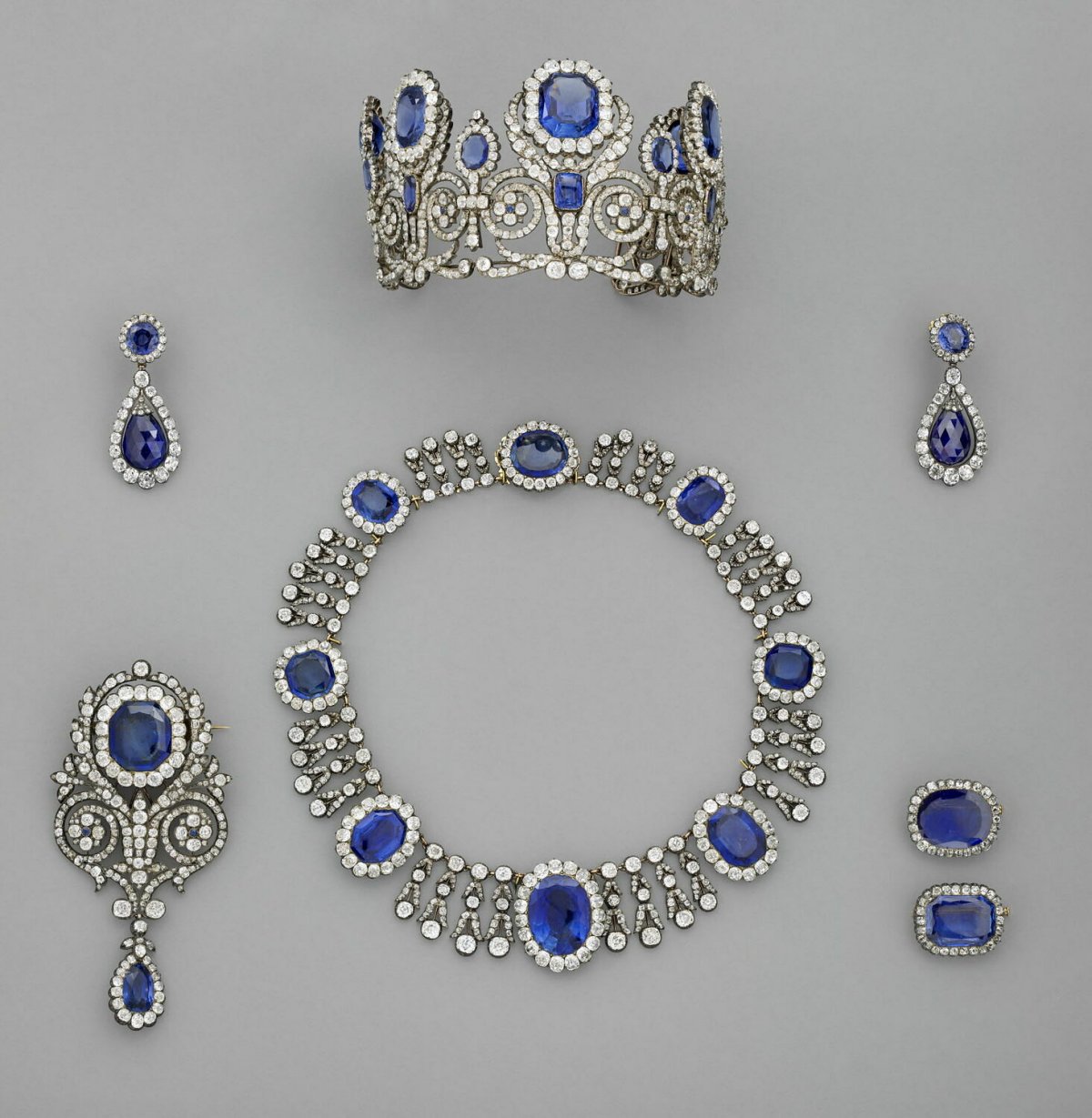
The grand sapphire and diamond parure that belonged to Queen Marie-Amélie, wife of King Louis Philippe of the French, was only complete parure on display in the gallery. The parure’s tiara was likely made using a set of sapphire and diamond brooches that had once belonged to Hortense de Beauharnais, daughter of Empress Joséphine. Louis Philippe purchased the jewels for his wife, and an unknown Parisian jeweler set the stones in this new parure for Marie-Amélie.
The sapphire parure remained with Louis Philippe and Marie-Amélie’s descendants until 1985. The Louvre Museum purchased the jewels from Henri d’Orléans, Count of Paris that year, and the set has been part of the museum collection ever since. The tiara, necklace, and earrings from the suite were stolen in the robbery.
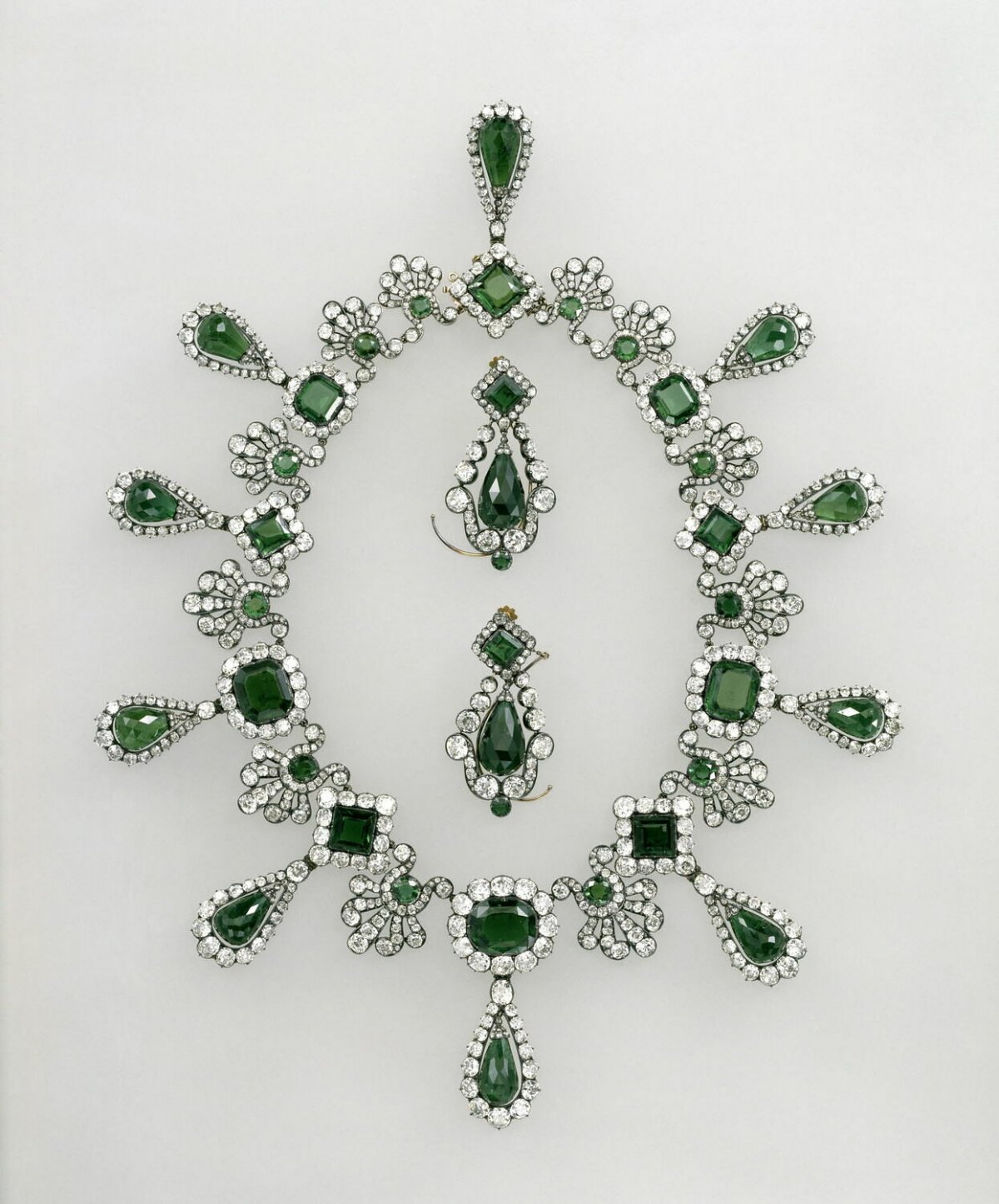
The grand emerald and diamond necklace that was taken by the thieves belonged to Empress Marie Louise, the Austrian-born second wife of Napoléon I. It was originally part of a complete parure offered by Napoléon to Marie Louise as a wedding present in 1810. Made by François-Régnault Nitot, the original set also included a substantial tiara, which is now part of the collection at the Smithsonian in Washington, D.C.
The necklace’s matching earrings were also stolen. The jewels had stayed with Marie Louise’s Habsburg relatives until the 1950s, when the set was sold to Van Cleef & Arpels. The necklace and earrings were later part of the collection of Baroness Elie de Rothschild. In 2004, the Louvre Museum acquired the jewels with help from the Heritage Fund and the Society of Friends of the Louvre.
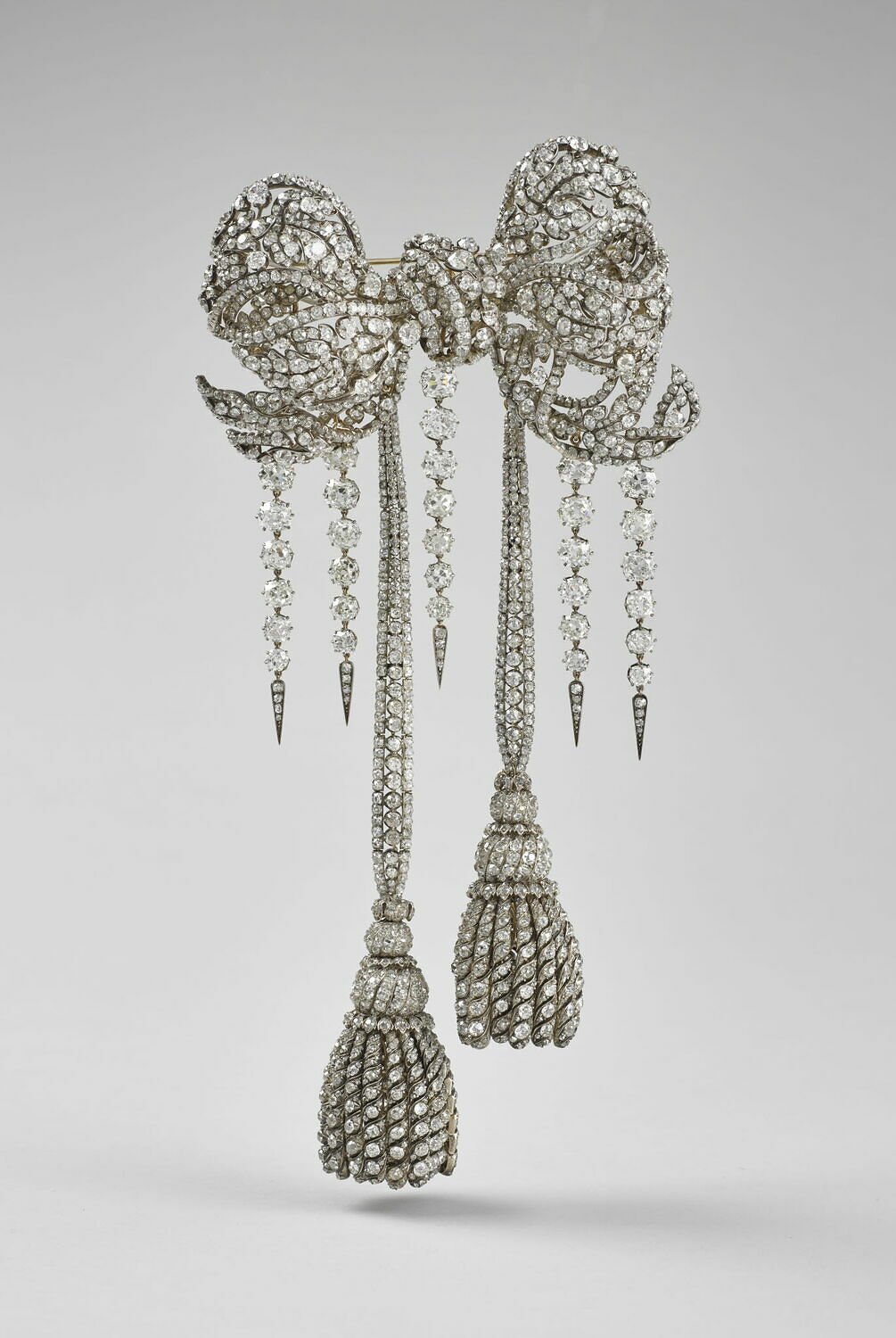
One of the largest “brooches” on display in the room was the grand diamond bow made by François Kramer for Empress Eugénie in 1855. The enormous jewel, which is set with more than 2000 diamonds, was meant to be worn as a bodice ornament. (Originally it was set as the centerpiece of a diamond belt.)
The diamond bow was sold at auction with the rest of the crown jewels in 1887. (Third Republic officials decided that year to divest the entire state jewelry collection, with the thought that if France had no crowns, it would never again have kings.) The enormous brooch passed through the collections of Caroline Astor and the Countesses Beauchamp before it was purchased by a jeweler in New York in the 1980s. The Louvre acquired the diamond bow in 2008 with help from the Heritage Fund and the Friends of the Louvre. It too was taken out of its case by thieves on Sunday morning, but it is reported to have been recovered on the scene.
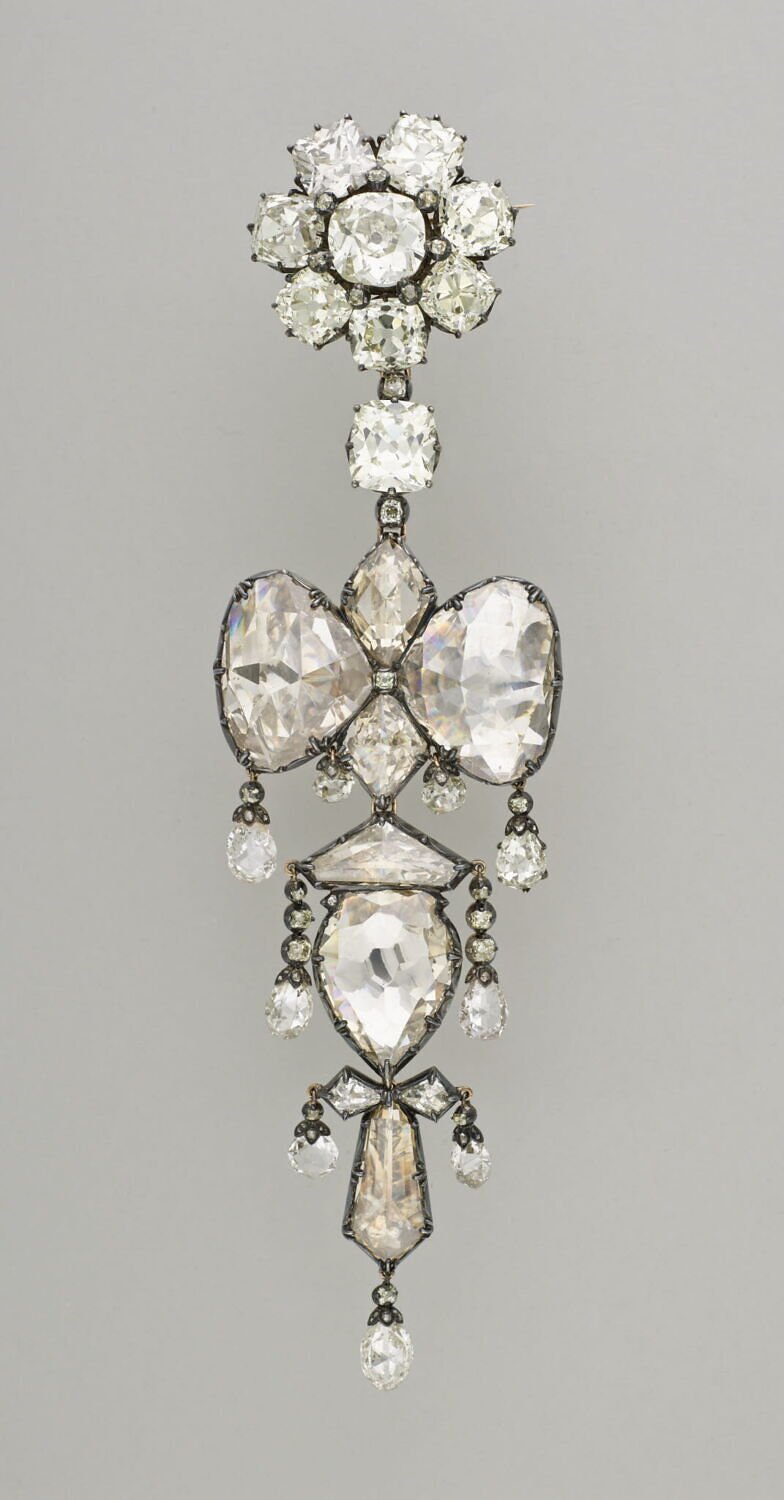
This diamond brooch, also taken from its case on Sunday, has traditionally been called a “reliquary brooch,” though no space for any relics appears to be incorporated into the piece. (Room for a relic may exist in the jewel’s original case.) It was made in 1855 by Alfred Bapst for Empress Eugénie, using stones from existing pieces of crown jewelry.
The two large diamonds set in the center of the brooch, which look almost like butterfly wings, are special: they’re part of the collection of Mazarin diamonds, bequeathed to the French crown by Cardinal Mazarin in 1661. The diamonds in the reliquary brooch are diamonds number 17 and 18 from that grouping. The brooch was incorporated into the Louvre’s permanent collection in 1887, the same year it was sold with the rest of the crown jewels. Luckily, the brooch was one of the pieces left behind by thieves when they made their escape.
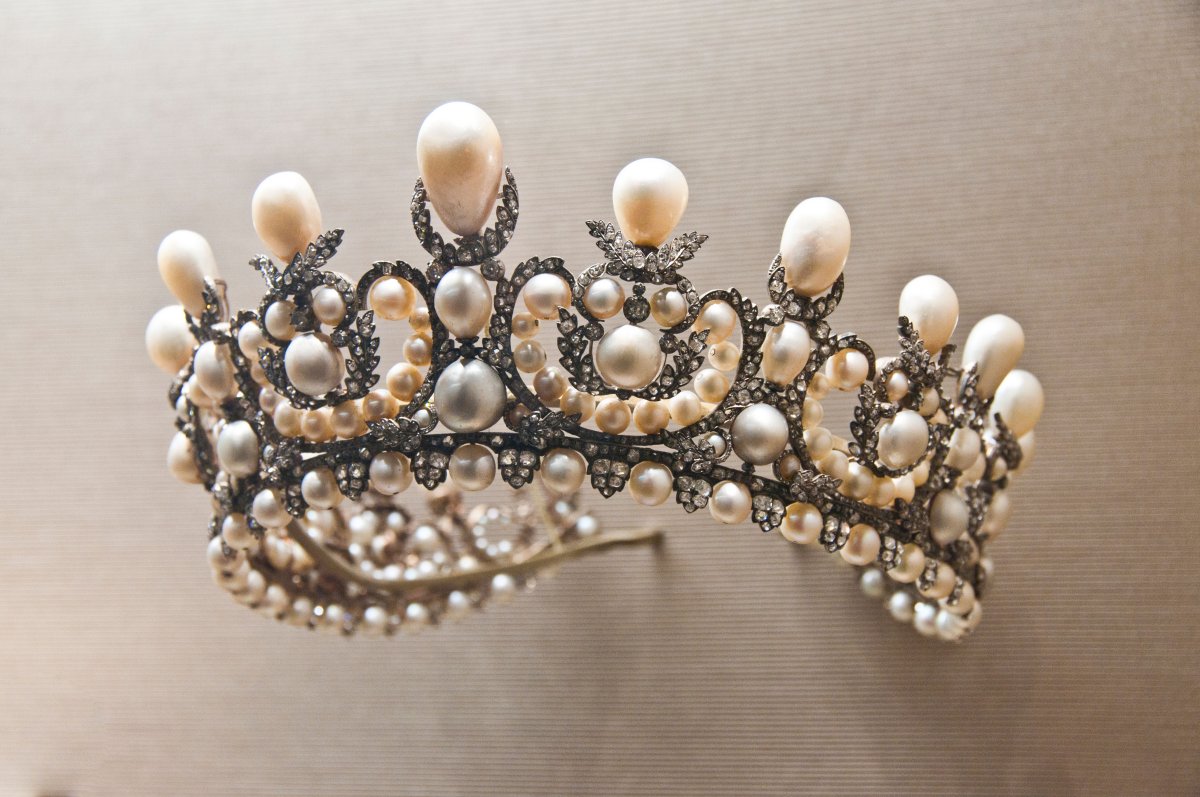
Rounding out the collection of jewelry in that first glass case was Empress Eugénie’s famous pearl and diamond tiara. It too was stolen. The diamond and pearl diadem was made by Alexandre-Gabriel Lemonnier in 1853 for Empress Eugénie. The jewel was one of her favorites, often worn by the empress in state portraits.
The tiara was sold with the rest of the crown jewels in 1887, and three years later, it was acquired by the Thurn und Taxis family. They kept it in their jewelry vaults until 1992, when Princess Gloria decided to sell the jewel, which she had worn for her wedding. It was acquired by the Louvre, as a gift from the Society of Friends of the Louvre, the same year.
It’s stomach-turning to think that these grand historical treasures may have vanished for good. I’ll keep you updated as we learn more, and I’ll be back here on Tuesday with regularly-scheduled royal jewelry content.
Leave a Reply
You must be logged in to post a comment.