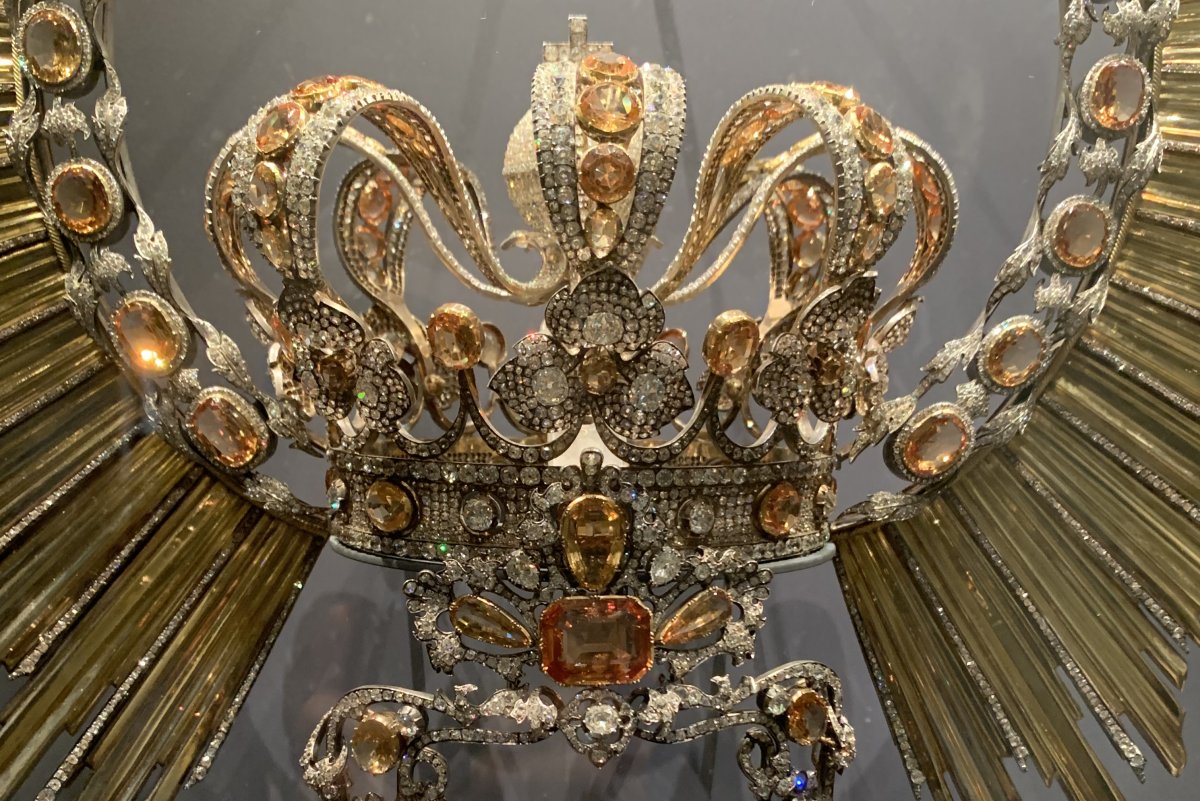
One of our community members recently made a fascinating visit to an exhibition of special royal jewels in Madrid, and she’s been kind enough to bring us all along with her. Let’s all join in today and take a closer look at the jewels of Our Lady of Atocha.
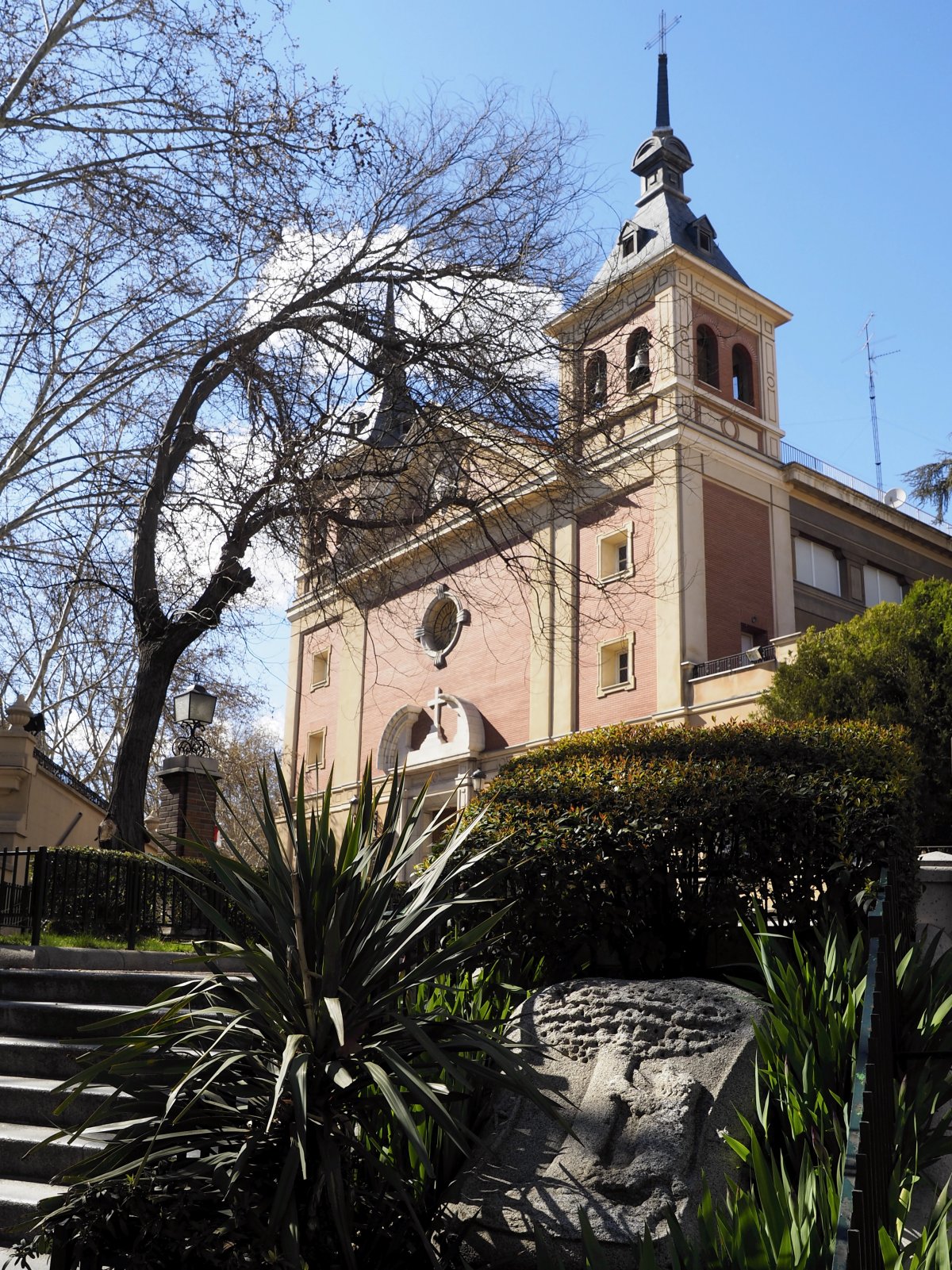
The story of this truly fascinating parure of royal jewelry begins in Madrid, at the old Dominican church of Our Lady of Atocha. A grander basilica, built in 1890 and renovated in the 1950s following damage in the civil war, now stands on the site of the church where generations of the Spanish royal family venerated the statue of Our Lady of Atocha. The icon is so named because it was found in tall grass after it was lost from its original home in a chapel during the medieval era.
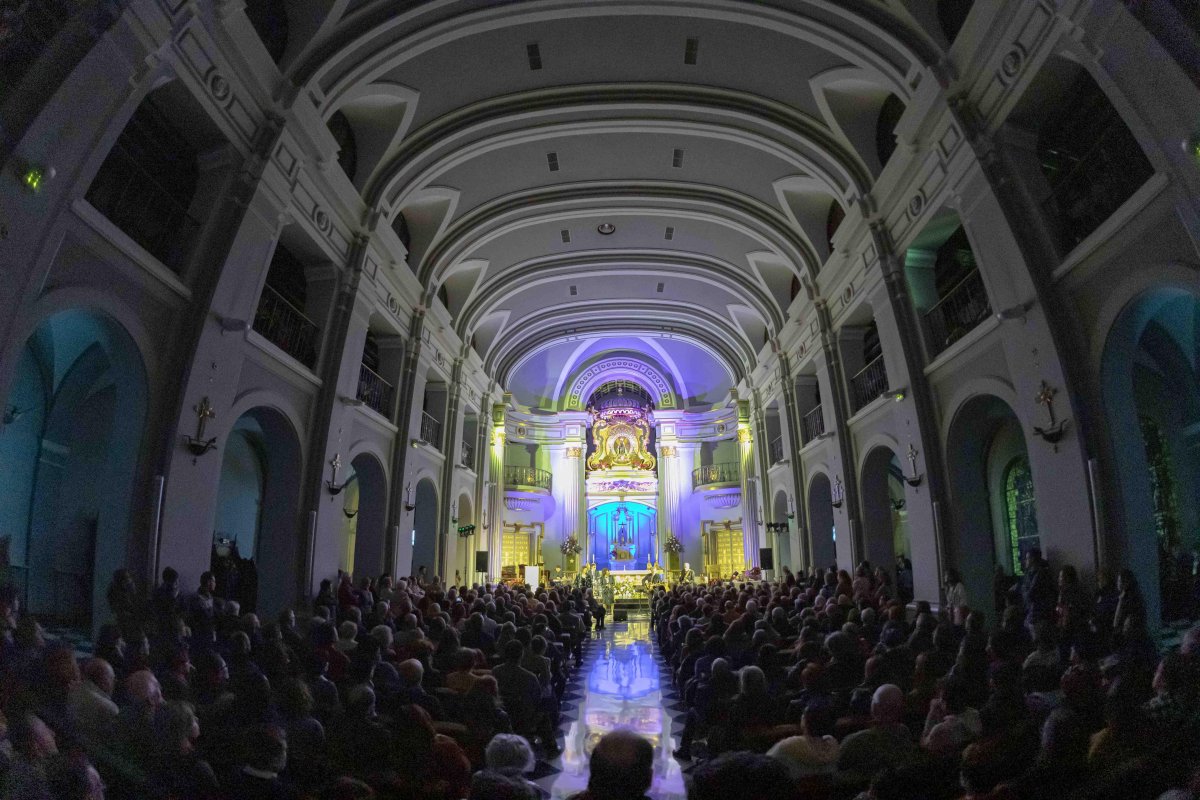
Here’s a view of the interior of the basilica. For generations, members of the royal family have come to the church to have their marriages and their newborn children blessed before the statue. Most recently, King Felipe VI and Queen Letizia, then Prince and Princess of Asturias, came to the basilica after their wedding ceremony in May 2004, and Letizia placed her bridal bouquet before the image.
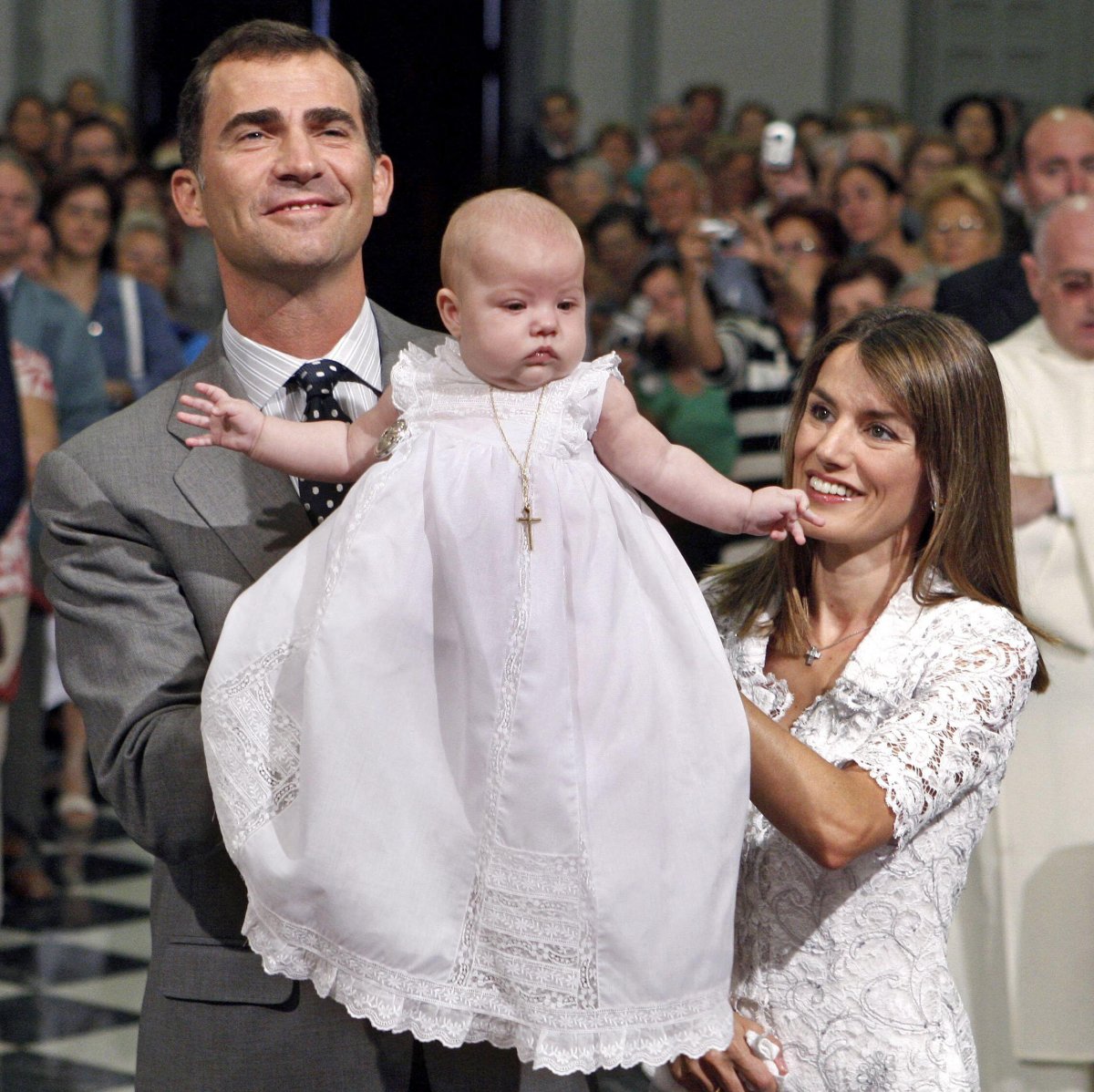
In 2006 and 2007, Felipe and Letizia also brought their daughters, Leonor and Sofia, to the basilica to be blessed. Here, the royal couple lifts baby Sofia to present her to the icon in September 2007.
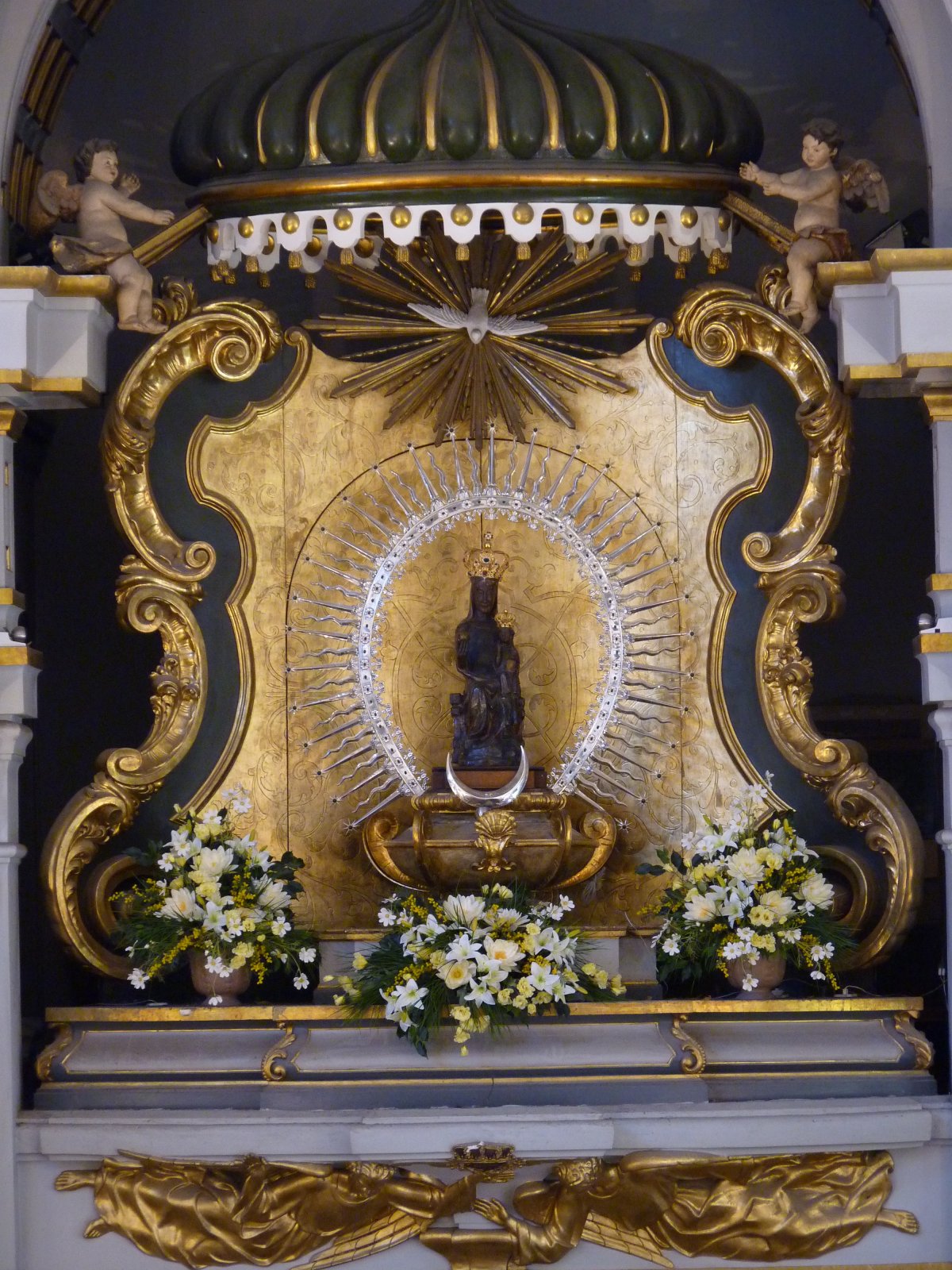
The icon, which is two feet tall and made of carved wood, is thought to date to the 7th century. The statue is shown here above the altar in the present-day basilica.
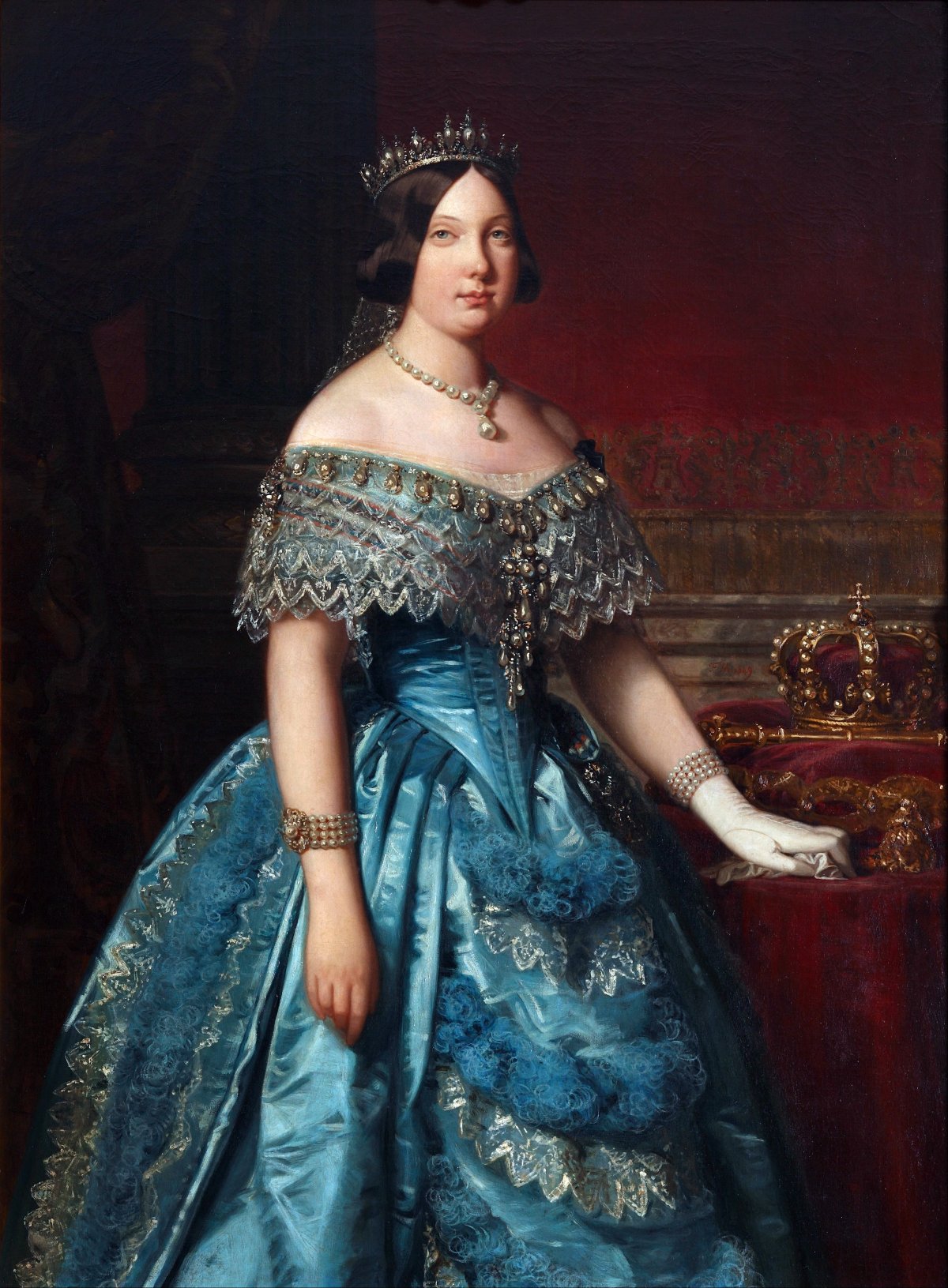
One of the more notorious chapters in the history of the church and its famous icon took place in 1852. Queen Isabel II, who had inherited the throne at the age of two, had finally given birth to a healthy heir. Her marriage to a cousin, the Duke of Cadiz, was not a success, and it’s believed by many historians that at least some, if not all, of her children were fathered by various lovers.
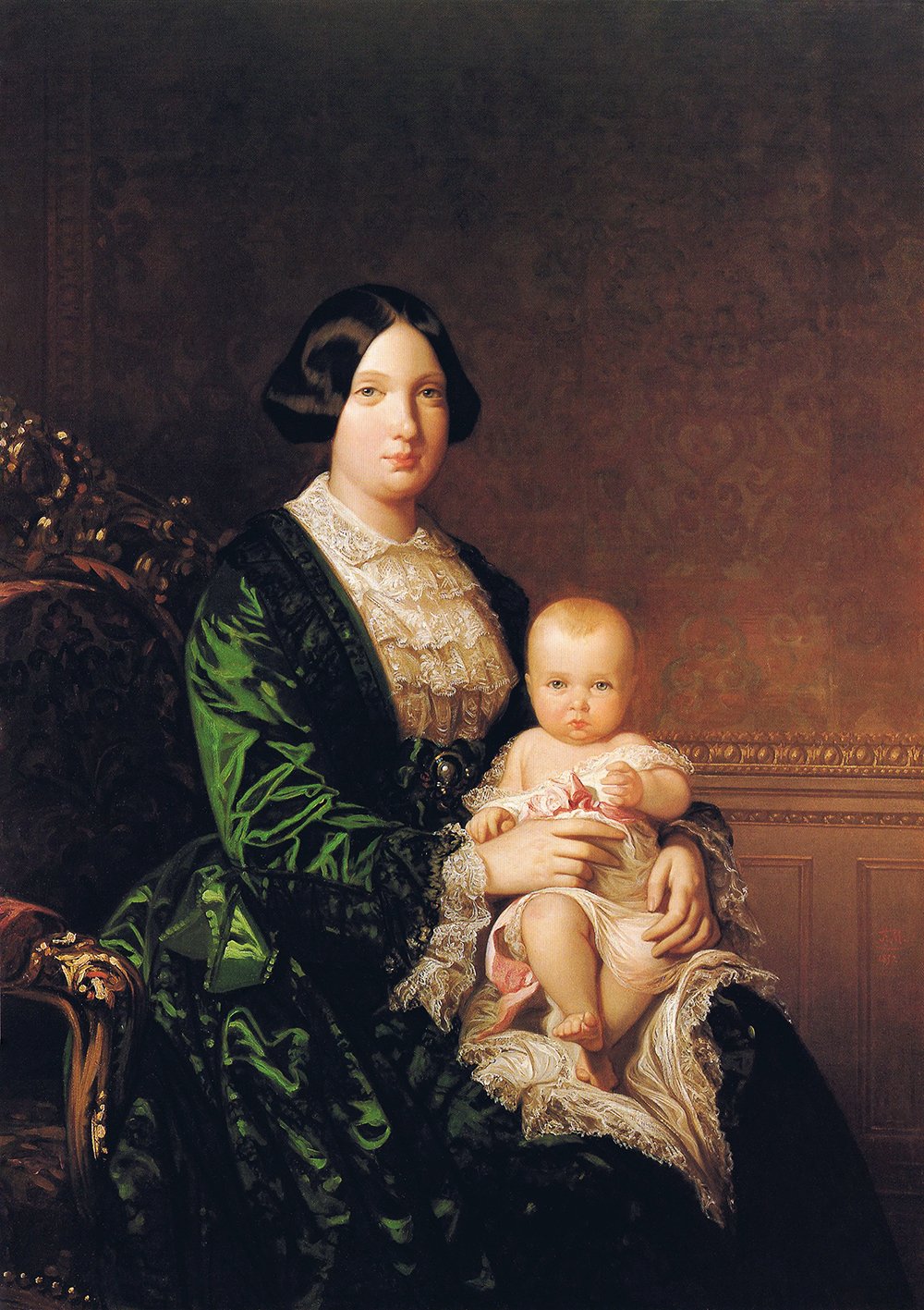
Isabel’s first two babies, Infante Luis Fernando and Infante Fernando Francisco, did not survive. The third, a daughter named Maria Isabel after her mother, was born on December 20, 1851. The baby’s birth was acclaimed widely by those who supported the Borbóns over the always-threatening Carlists. Little Isabel was given the title of Princess of Asturias, which she held until the birth of her younger brother, Infante Alfonso, in 1857.
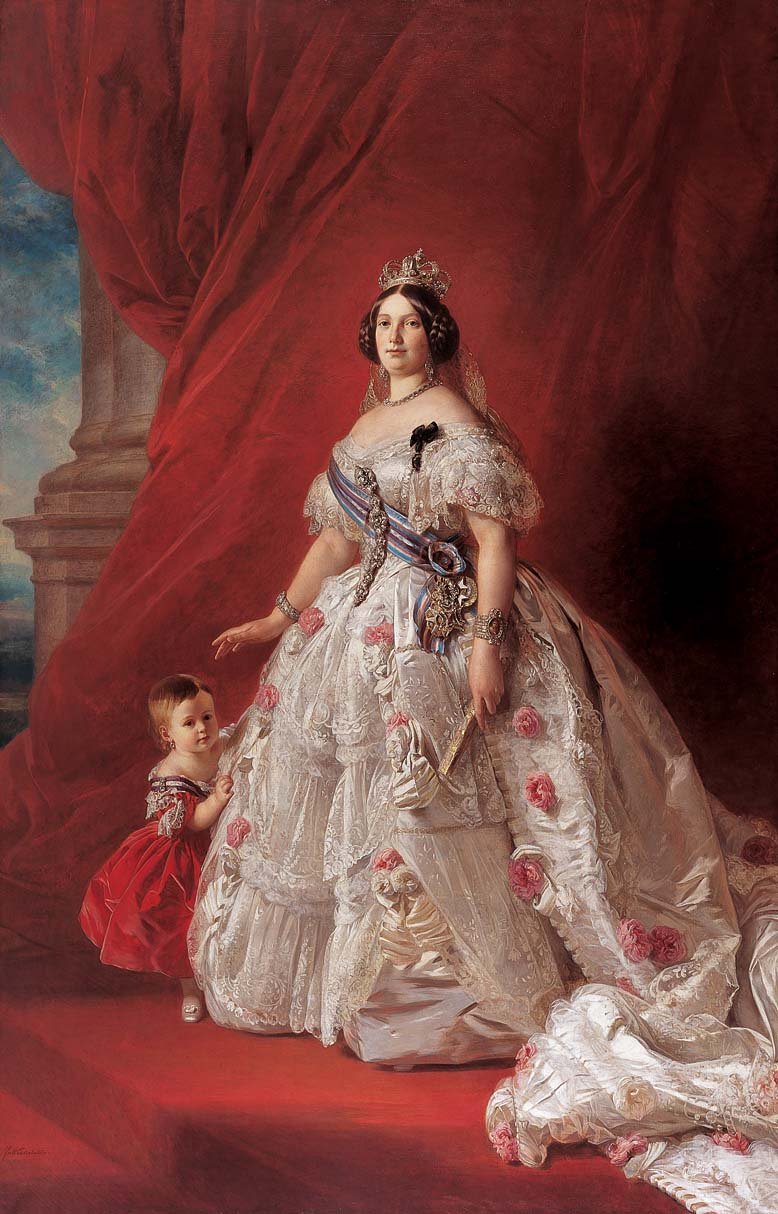
Little Isabel was baptized on the day after her birth. In February 1852, Queen Isabel prepared to make her way across the city to present her beloved daughter to the icon of Our Lady of Atocha at the Dominican church. The Queen attended mass at a chapel inside the Royal Palace before heading out for the journey to the church. Just as she stepped out of the chapel, she was surprised by an attacker, an ordained but itinerant priest, Father Martin Merino y Gomez. Sources differ slightly on what happened next. Father Merino, who was in his early 60s, approached her, either bowing to kiss her ring or attempting to deliver a message to her. As the Queen held out her hand, he produced a stiletto from his robes and stabbed her.
Luckily, Isabel was wearing a heavy, ornate gown for the special occasion. The stiletto glanced off her arm and sliced the side of her abdomen. She was thought to have been saved from a deeper wound by the embroidery on her dress and the whalebone stays of her corset. Isabel was frantic, mostly concerned about the safety of her daughter, as guards hastily dragged the attacker away. She quickly recovered physically, though the attack left her with nightmares. She did reportedly ask for clemency for the would-be assassin, but he was tried and executed within a week of the incident.
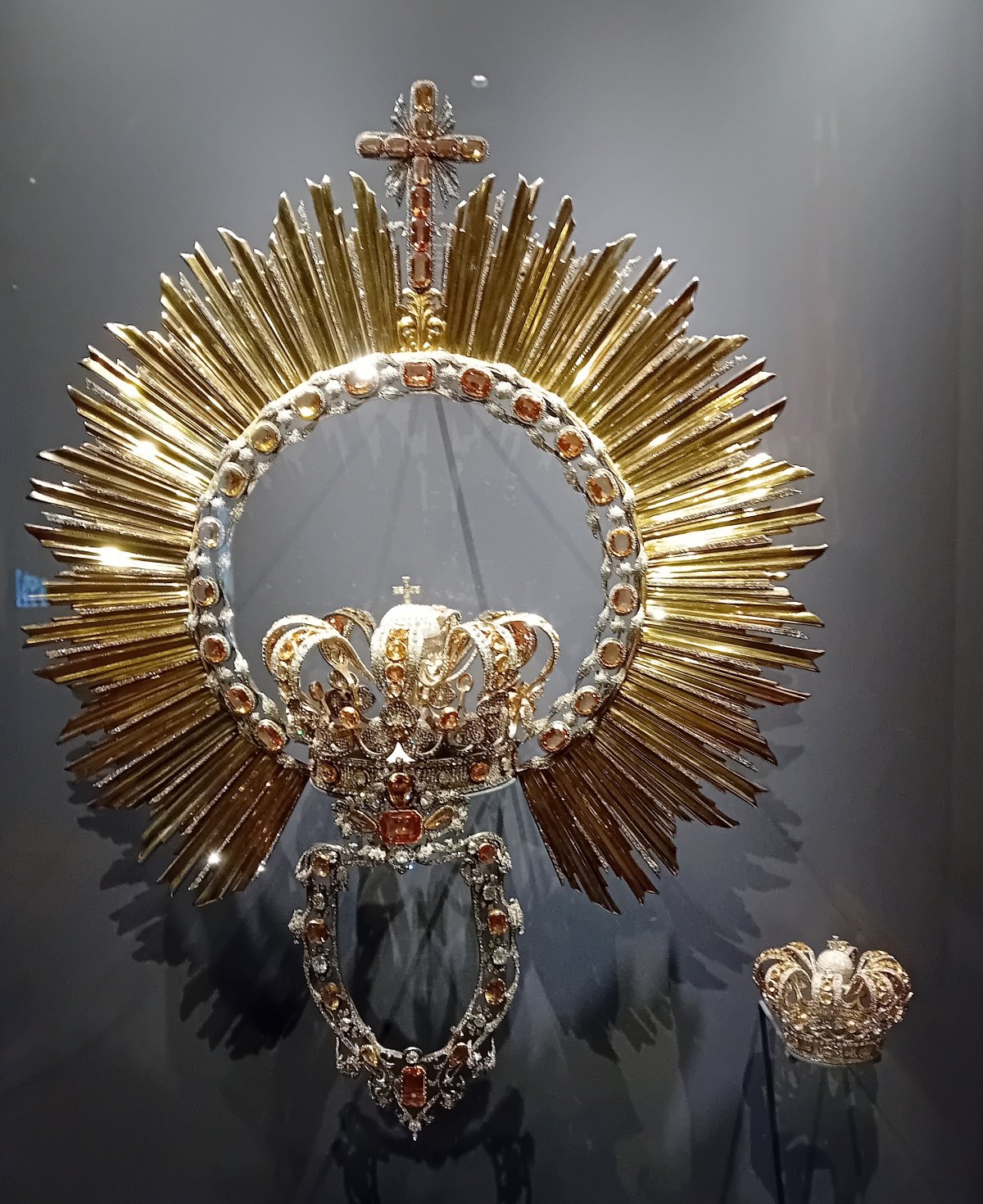
Isabel was convinced that Our Lady of Atocha had helped protect her during the attack. A few weeks afterward, she resumed her pilgrimage to the church, this time to give thanks both for her daughter’s birth and her own lucky escape. She traveled across Madrid in a grand procession. As a gesture of thanks, she presented the jewels she was wearing during the assassination attempt, an elegant parure of diamonds and Brazilian topazes, set in silver and gold, to the image. She also petitioned Pope Pius IX to elevate the church to a basilica, which he did in 1863.
The parure, which included a diadem, a necklace, and several bracelets and rings, was entrusted to Narciso Praxedes Soria, the royal goldsmith and diamond cutter. He was asked to adapt the jewels so that they could be placed on the statue. The Spanish Royal Collection calls the task “the most important commission” of Soria’s career. He used the stones and materials from the parure to craft a pair of crowns—one for the Madonna and one for the Christ Child—as well as a medieval-inspired wimple and a grand halo.
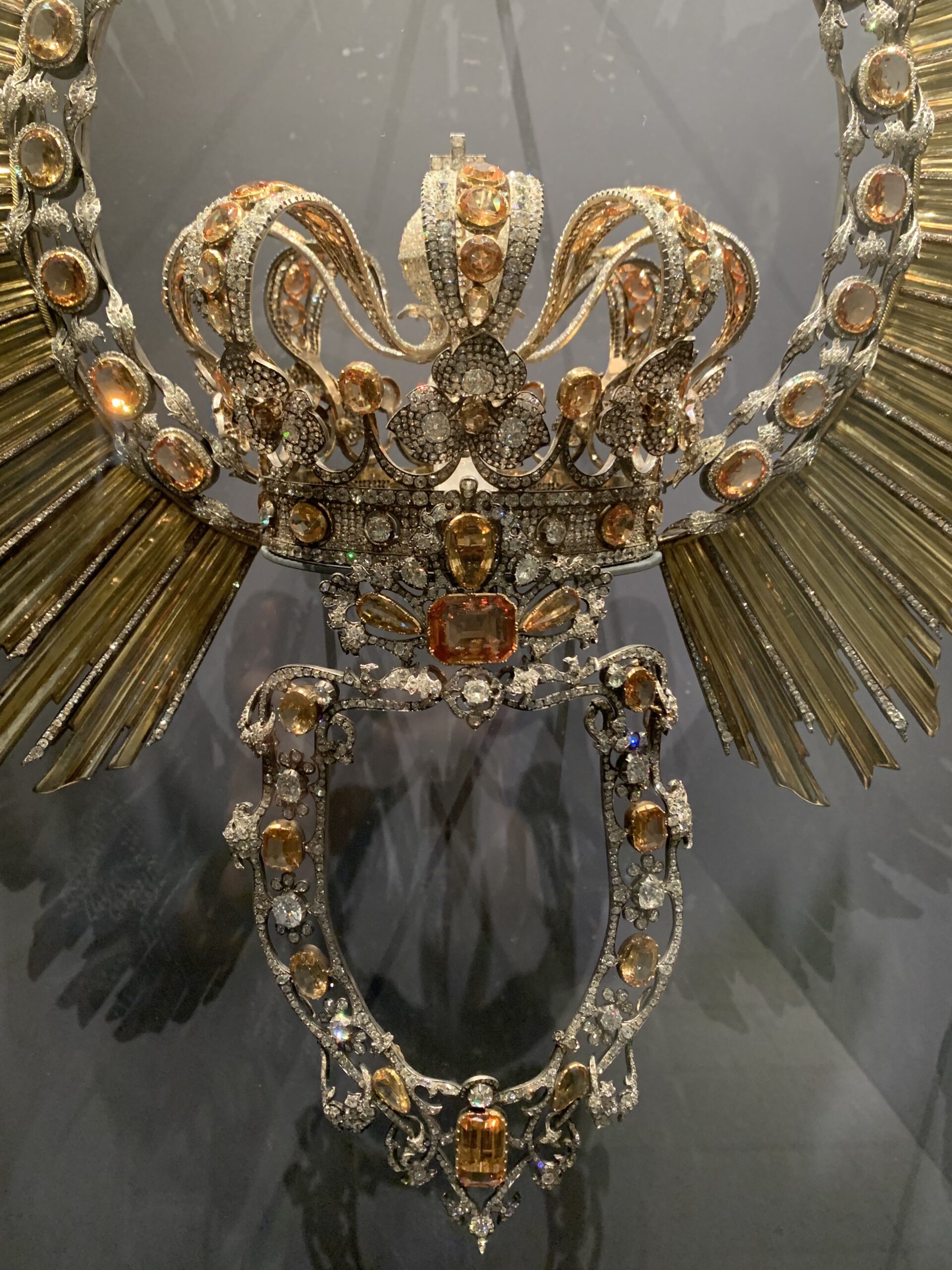
The jewels are now housed in La Galería de las Colecciones Reales in Madrid. There, our friend Miss Glossop recently visited the pieces and took these gorgeous close-up photographs of the jewels for us to enjoy. “As you can see,” she told me, “the work is exquisite.”
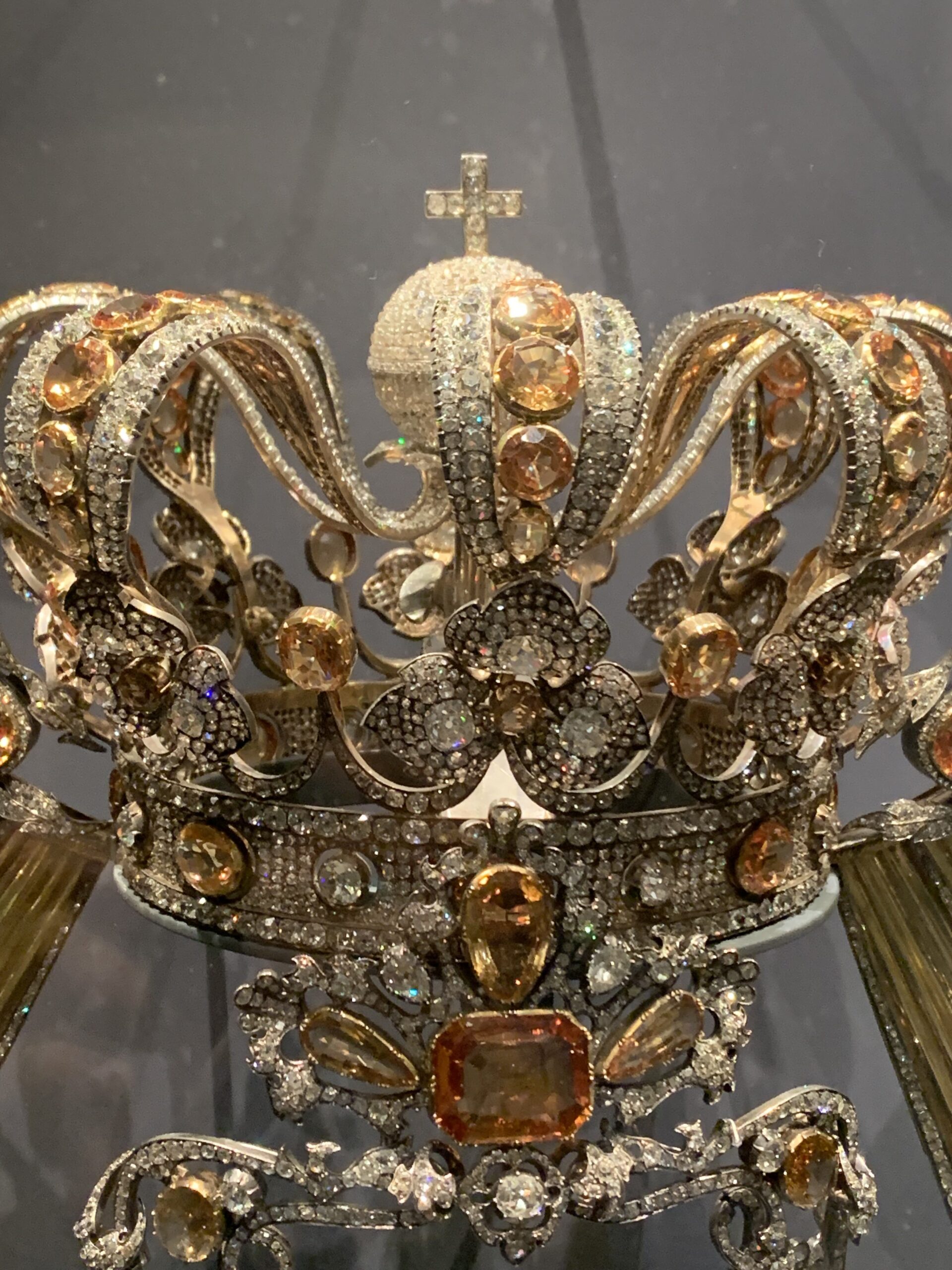
Here’s a close-up of the larger of the two crowns, which was made for the Madonna. The website of the Royal Collections Gallery notes, “The crowns of the Virgin and Child share the same design and reflect a popular aesthetic: a band formed by three bands studded with precious stones, the central one being wider, surmounted by a crest of clover leaves intertwined with vegetal motifs. From this crest rise eight imperial arches, repeating the design of the band but with two bands of diamonds enclosing a band of topazes, which join at the top to support the orb and cross.”
The crown is smaller in real life than the images suggest, with a diameter of 14 centimeters and a height of just 16 centimeters, which should give you a general idea of the size of the whole set.
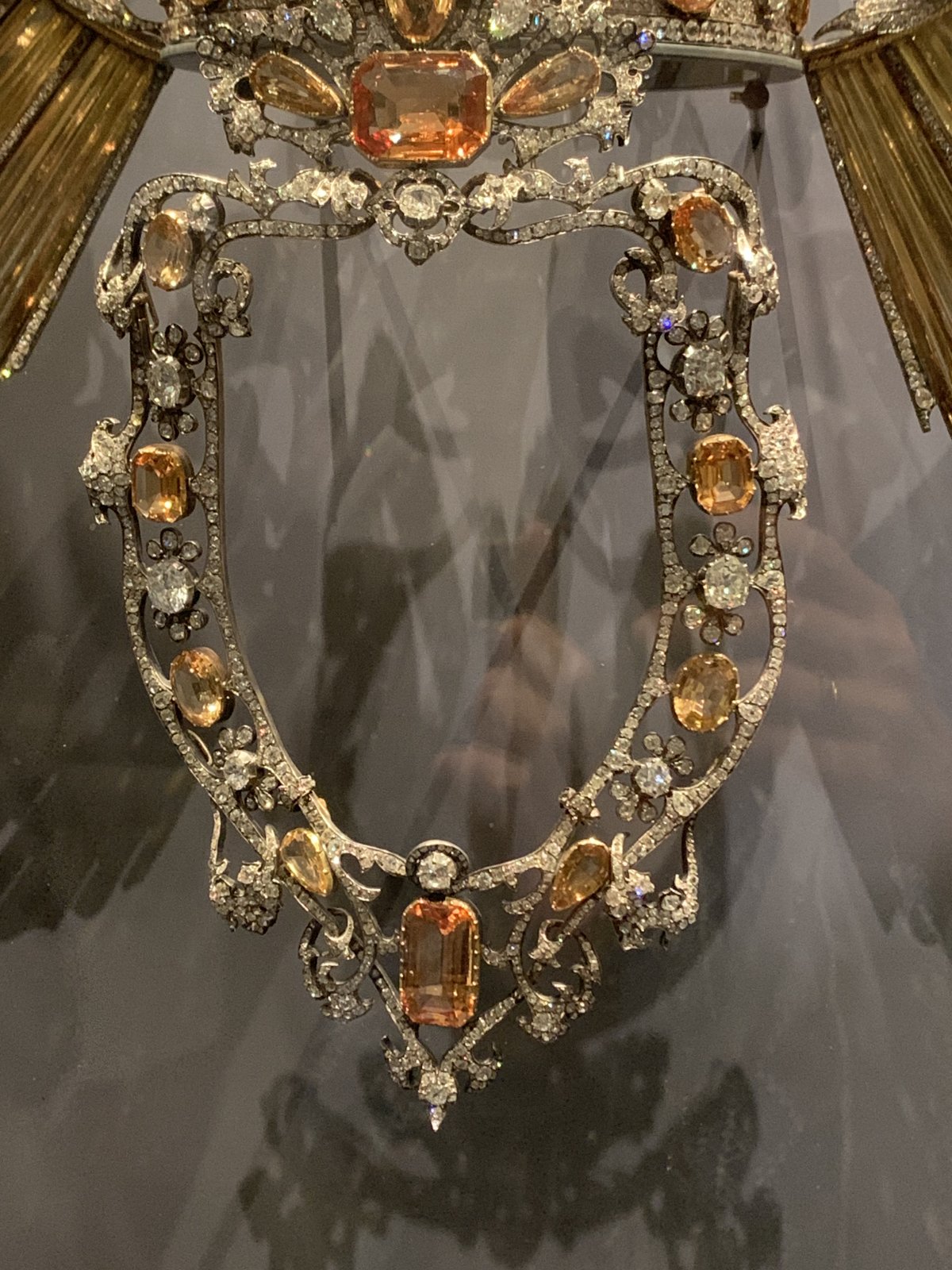
And here’s the wimple, or rostrillo, which features “a foliate design with interlaced ribbons of openwork contours and a crest at the top,” per the gallery website. The ornament is intended to frame the face of the Virgin Mary.
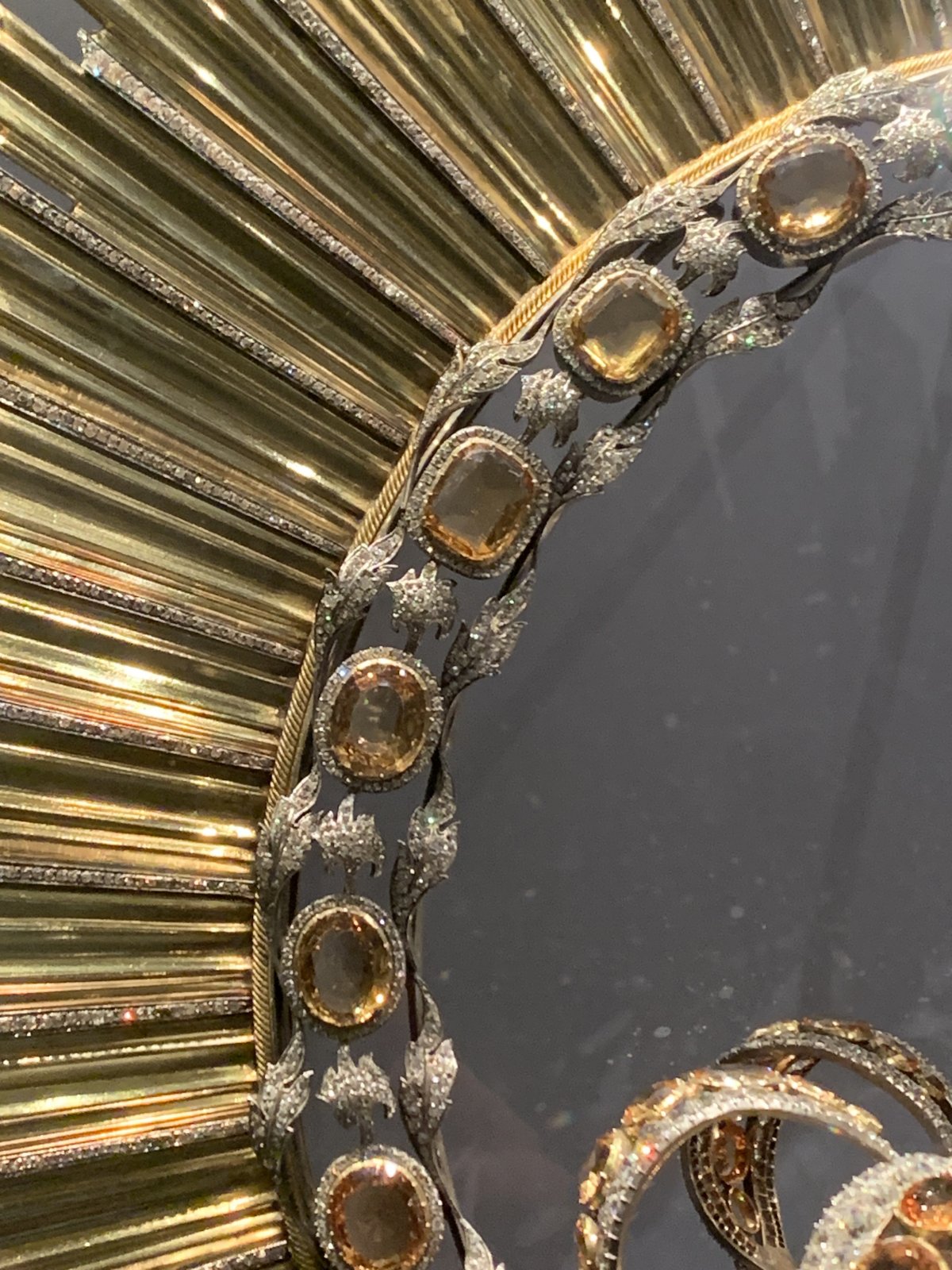
And here’s an excellent close-up of the detailed work on the interior edge of the halo, which features honey-colored topazes surrounded by diamonds, set in a border of delicate diamond leaves.
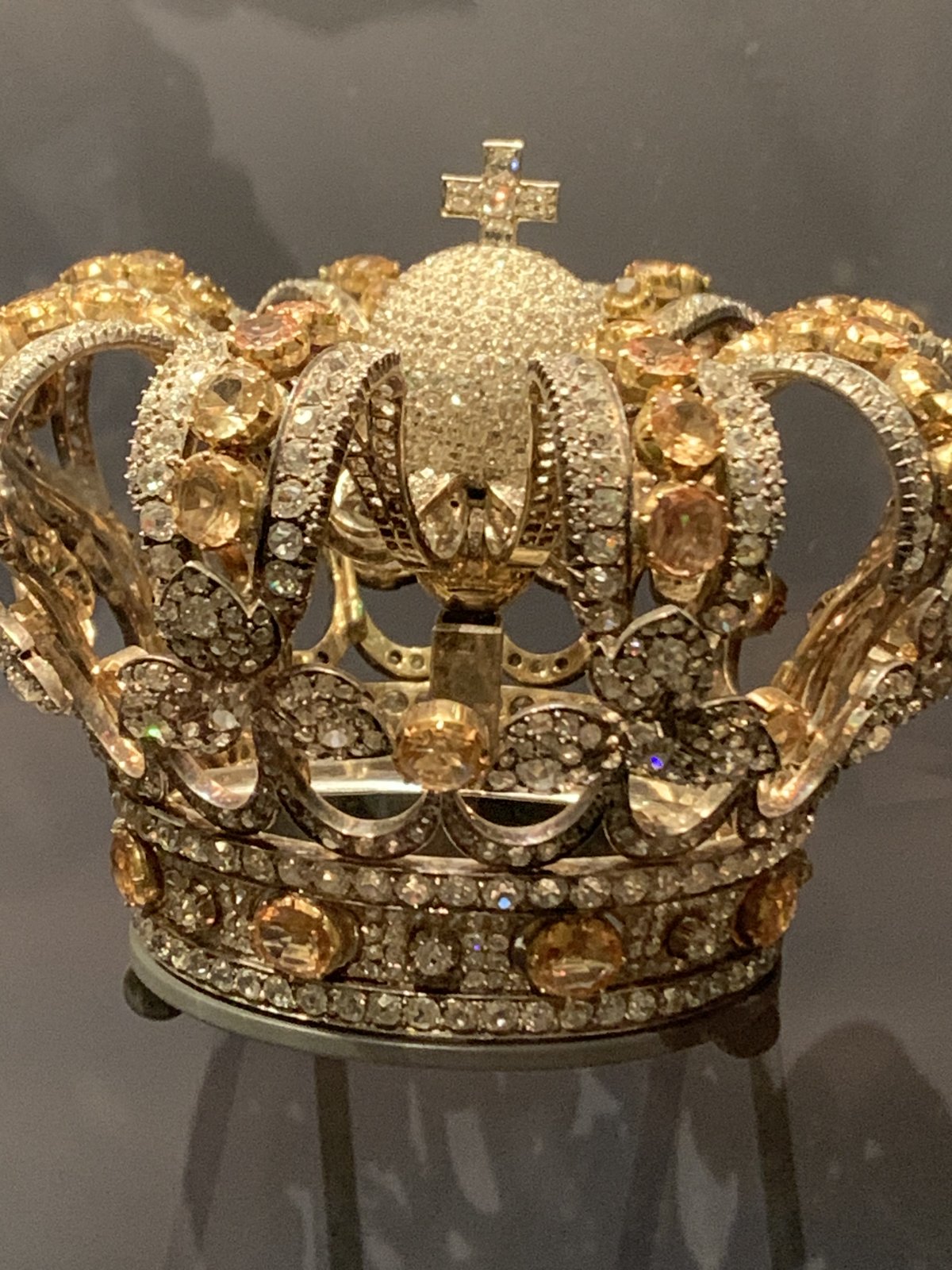
And here’s the smaller crown of the two, intended to be placed on the Christ Child. The jewels were “worn” on occasion by the statue, along with a bouquet of diamond flowers, which has since disappeared. Today, the topaz parure is part of the Royal Collection, house at their gallery instead of at the basilica.
Please join me in extending a huge thank you to Miss Glossop for so generously sharing photographs from her visit with all of us! It’s so fun to go exploring around the world with all of you!
Leave a Reply
You must be logged in to post a comment.